

Follow the money
How school funding is allocated, constrained, and reshaped by district policy and the bureaucracy
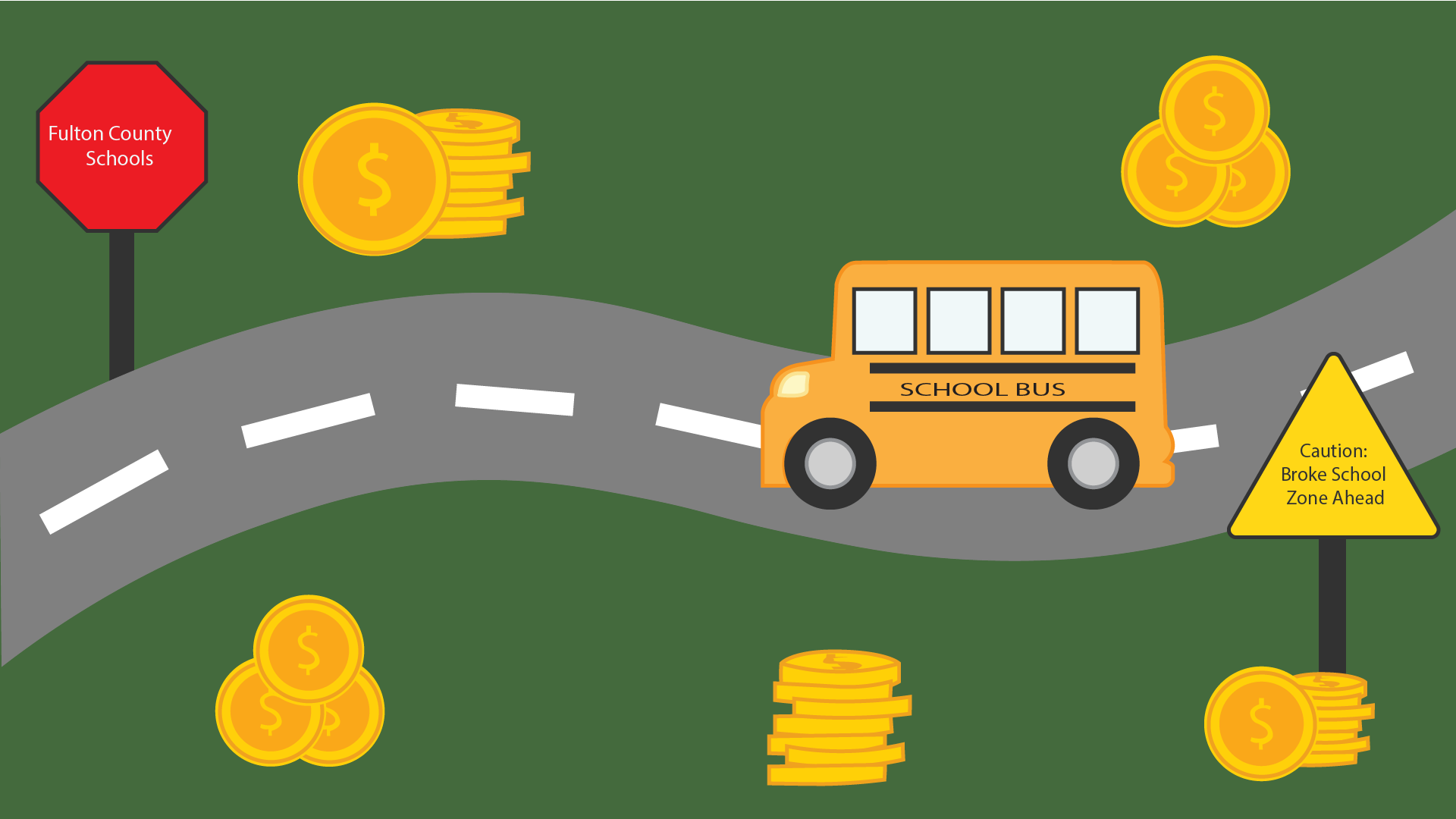
Design by Allen Liu and Arshita Sunnam
Allen Liu, Copy Editor, Arshita Sunnam, Opinions Editor, & Ansh Vigh, Sports Editor
Education and funding have been a feud as old as time. But a common misconception is about where the disagreement lies. It's never about whether education matters: that one's a given. The real fight is about who pays for it, how the money is distributed, and what schools are expected to accomplish with what they're given. Teachers are supposed to deliver results, meet new standards, expand programs, and support students in every possible manner, all while classroom rosters balloon and paychecks shrink. The problem is not just a "lack of money." Rather, it's a system where funding decisions are shaped by politics, tax cuts, and layers of bureaucracy long before they ever reach a school building.
In Georgia, that system has been under stress in recent years. For the past five years, the Education Special Purpose Local Option Sales Tax (ESPLOST) has sustained Fulton County Schools' (FCS) funding. In its totality, ESPLOST is projected to generate a whopping $1.2 billion in revenue. These proceeds finance a litany of capital improvements, including facilities, technology, safety & security, buses & transportation, furniture & equipment, and other fiscal responsibilities. FCS then further splices and distributes that revenue to its 102 elementary, middle, high, and charter schools; 10,900 full-time personnel; and 86,031 students.
That's why, despite FCS' one-of-a-kind budget, money doesn't instantly translate into classroom improvements. Because the funding is split across dozens of departments, hundreds of schools, thousands of employees, and decade-long capital projects, the money gets stretched thin, and progress moves like molasses. And when your school system's budget summary alone is 446 pages long, it's clear that bureaucracy has become part of the problem.
Furthermore, FCS faces funding challenges that extend far beyond internal budget distribution. Recent policy changes now threaten the very size of the funding pool itself, placing additional pressure on an already buckling system. On Nov. 4, 2025, nearly 76% of Fulton voters approved two tax-break measures for the FCS portion of seniors' homestead property taxes. That means select Fulton homeowners can cut up to 50% from their school property tax. Property tax expert Colton Pace assessed that FCS budgets would need to be able to fill a "massive hole."
National issues only serve to compound funding issues at an even larger scale. On March 20, 2025, President Donald Trump's executive order dismantled the Department of Education (DOE), with authority going back to the state and local levels of government. Due to this order, the Georgia Department of Education (GDOE) lost around $220 million for K-12 education, while FCS was at risk of losing $49 million as of April 2025. As a result, Superintendent Mike Looney announced that within the next four or five years, the county needs to cut $95 million from the budget. Martin Neuhaus, principal of Northview High School, explains how these tax cuts impact our school funds.
"That's a $60-80 million a year shortfall because of a change in the county's tax digest...Fulton County is having budget issues because of that change, but also because of declining enrollment," Neuhaus said.
One of the recurring solutions to the recent budget problems has been to cut "steps" from teacher salary schedules. The FY26 Fulton County teacher salary schedule displays the current criteria for salary raises and deductions. There are two main considerations: duration of employment and degree of education. A teacher who has worked 27+ years at an institution and received a doctorate will receive at most $121,741. A teacher with a bachelor's just starting at a new school will receive $60,506 and will receive pay increments or "steps" of approximately $1500 for each consecutive year of employment.
That progressive system screeches to a halt under G.L.I.D.E, FCS' new "revenue-generating and cost-reduction recommendations." Stipulation 15 proposes a "Step Freeze," which would eliminate certain annual increases, meaning teachers would receive no additional compensation despite completing another full year of service. This recommendation would save an estimated $15.4 million. For many teachers, the “Step Freeze” translates into lost income for a year of service and commitment already completed, with real consequences for rent and mortgage payments, groceries, childcare, and more.
Another initiative from G.L.I.D.E to reduce expenditures is to abolish the “senior reduction” option, which previously allowed seniors on track to graduate to drop one class period per semester. FCS officially listed this option for the past years, letting seniors ease their schedules while still finishing required credits, but stipulation three has since removed it for the upcoming 2026-27 school year. County policymakers argue that removing this choice will help ensure students are better prepared for college and careers by keeping them in more classes. However, critics see it as a funding-driven decision, not an educational one.
On May 21, 2026, teachers could face yet another blow to their paychecks under a proposed "District-Wide Furlough for All Employees" in FCS. A furlough is a temporary, unpaid leave that requires staff and personnel to work without compensation. During recent Board Work Sessions, officials presented the measure as part of ongoing efforts to address budget constraints. If approved, the furlough is expected to save the district approximately $4.5 million. Still, the decision is likely to spark controversy, as many critics question whether the budget should come at the direct expense of teachers.
Another policy implemented for the coming year is a five-period minimum attendance requirement. Under this rule, any off-campus option, such as dual enrollment, internship, or work-based learning, would have a limit of two periods; the rest must be on campus. Proponents advocate this restriction as a way to support student engagement and safety, but opponents point out that it directly ties student schedules to budgets.
The budget challenges facing FCS are not the result of a single decision, but rather long-standing structural pressures that have narrowed the district's financial flexibility. Bureaucratic funding distribution, local tax exemptions, declining enrollment, and the loss of federal funding have reshaped how money moves through the system. As a result, policies like step freezes, adjustments to student schedules, attendance requirements, staffing strategies, and spending priorities are increasingly shaped by how schools are funded rather than by any educational philosophy.
As FCS continues to navigate these constraints, transparency around funding structures and long-term planning will remain essential to ensuring that financial decisions align with students' best interests. At the end of the day, budgets tell the story administrators won’t, and if you want to understand who really pays the price:
Follow the money.