

The house always wins
Gambling became an inescapable reality of modern culture
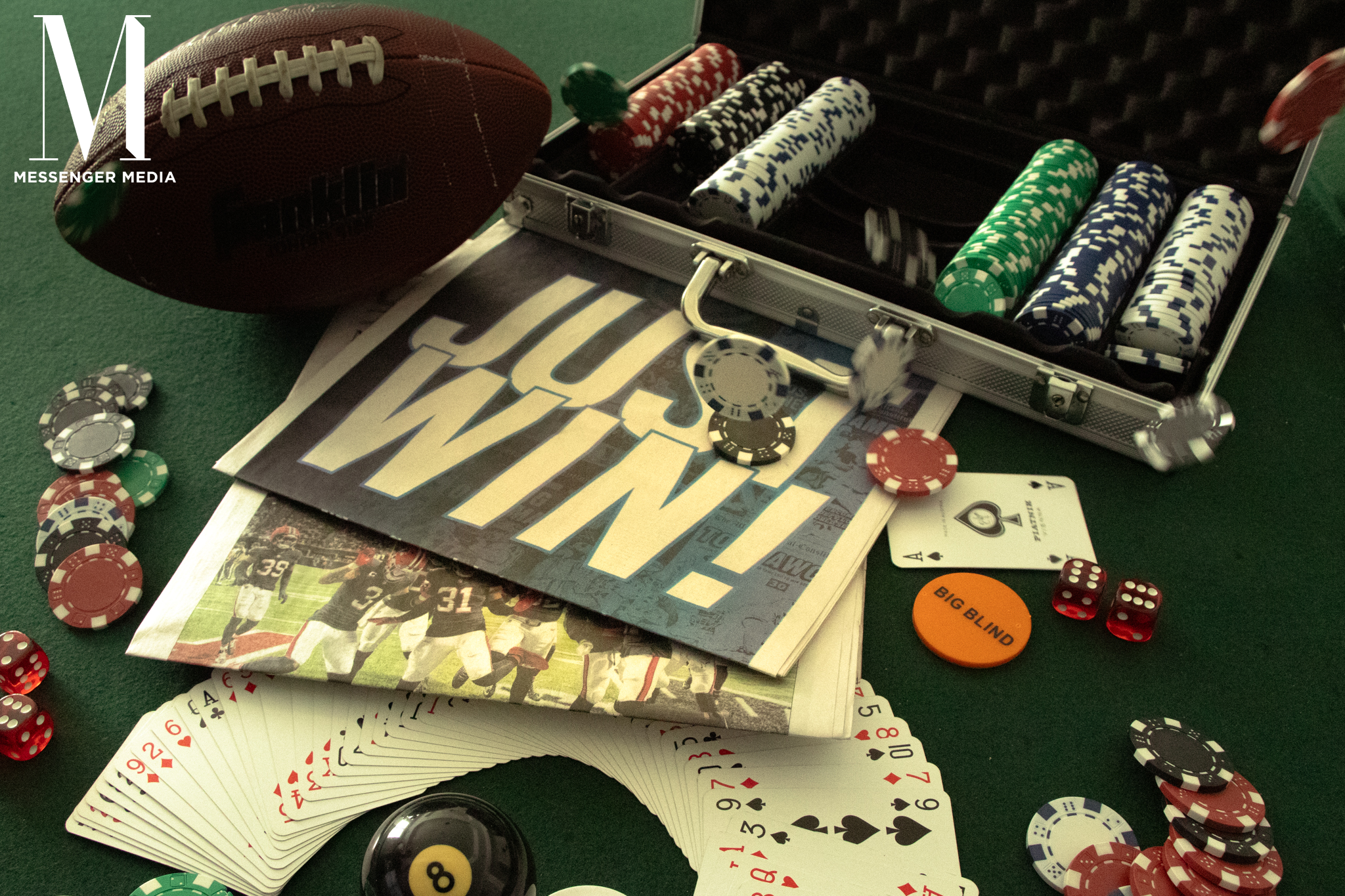
Photo by Allen Liu
Allen Liu, Copy Editor, Ian Sands, Photography Editor, & Zulfah Muzammil, Staff Writer
A spin of the wheel, a roll of the dice, a draw of the cards: these were once the defining symbols of the gambling industry. For years, gambling promised a quick, fast, and easy path to generational wealth, enticing people with the illusion of instantaneous success. That promise of lavish luxury, however, lured countless into bankruptcy. In essence, gambling was a gilded dream that many aspired to reach, but few ever did.
For a time, this reality mostly confined itself to the city of Las Vegas, Nev., or the felt carpet and 20 euros entry fee at the Monte Carlo Casino in Monaco. Nowadays, however, if one wishes to bet their life savings away, the only trip they must make is from the home screen of their phone to the FanDuel app. This increasingly digitized and mass media form of gambling has created an entirely new beast. Gambling in the 21st century has revolutionized the way Americans across generations approach sports, gaming, current events, and addiction.
Most notably, this novel gambling curse has begun to attract a new audience: the underaged. In the United States, the legal age requirement to gamble is 18 years old for the lottery and bingo. In Georgia, gambling broadly is defined as "betting on games or contests or playing cards, dice, or ball games to win money or valuable items." However, with the advent of digitized gambling, more and more underage individuals are finding ways to work around this barrier. In fact, gambling among kids aged 12-17 has quadrupled in just the last two years. Kids use VPNs, their parents' accounts, and many other means to bypass legal restrictions.
Sajad Beg, a senior at Denmark High School and an adept gambler, remarks on the ease with which the youth can gamble.
"They tell you that you have to be eighteen, but they never check because it's not regulated by the U.S. Federal Government. They don't need your Social Security Number, so there are really no checks," Beg said.
In addition to the open access to gambling, the scope of gambling has also widened exponentially. The activity has become pervasive in nearly every industry, including sports, technology, the stock market, films/movies, and more. In particular, the rise of "prediction markets" has transformed real-time political, economic, and cultural events into betting opportunities.
"Whether or not [President] Trump will say this word or that word. Whether or not the U.S. will acquire parts of Greenland. The outcome of the 2024 presidential election. There are genuinely billions of dollars being traded everywhere," Beg said.
In addition, smartphones now allow people to place bets instantly, anywhere, at any time, and apps use constant notifications to keep users trapped in the cycle of winning, losing, breaking even, and so on. This convenience has made sports betting especially appealing, cementing it as the most popular option among aspiring gamblers.
There's no betting medium more prevalent in the entertainment age than sports media. It seems like you can't turn on the TV without seeing an ad for DraftKings, FanDuel, BetMGM, or a litany of other sports betting apps. It's ingrained itself so much in modern culture that you cannot simply watch sports anymore; you have to make a parlay, which is a series of bets on a sports game, or a bracket. Take ESPN, for example, which named DraftKings as its official sportsbook. With this partnership came lots of advertising; ESPN displays DraftKings odds on every broadcast, they have a tailored sports betting app with DraftKings as the foundation, and they run DraftKings commercials during almost every break. It would be nearly impossible to use ESPN without hearing about DraftKings nonstop. This is far from the only example; other networks like CBS and FOX have similar exclusive deals as well.
With these instances, there is at least some degree of separation between the broadcaster and the sportsbook, but in the case of Fanduel, that distinction does not exist. Fanduel recently made a deal with Bally Sports, a major provider of baseball and basketball, to rename their stations with Fanduel branding, thus compounding their influence on consumers
There's no denying that betting has ingrained itself in sports, and when someone who is wanting to watch a game gets constantly shown ad after ad for a betting site, they will inevitably start to give in. That's why in 2024, the revenue for sports betting was 13.71 billion dollars, a 25.4% increase from the year before. This statistic is even more surprising when coupled with the fact that 43% of American adults view sports betting's legality as a grim addition for society. Most people understand the dangers of gambling, but many differentiate traditional gambling from sports betting. They feel that sportsbetting is not as serious and not as dangerous as poker or slots, but functionally, they are the same.
Mark Anderson, a social studies teacher at Northview High School and professional poker player, discusses the futility of sports betting.
"You are not smarter than the algorithms or the professional odds makers that make these bets...You're going to do no better than fifty over fifty. And because the app takes a percentage of your winnings, you are a loser in the long run," Anderson said.
Just like how someone can go all in on a poker hand, others bet thousands on a parlay. In both of these scenarios, all that money may vanish in an instant. It is reminiscent of a similar situation from the past, and how another massive industry became so woven into the seams of society that it eventually burst.
It's the 1960s, America has put a man on the moon, people are going to diners and listening to rock and roll, and everyone is smoking a Marlboro cigarette. Nowadays, nearly everyone understands that smoking is dangerous and deadly, and back in the day, people knew that as well. However, just like gambling, the heavy advertisement made it normalized in society. It's only when the craze made its way to the youth, and the harms of smoking became too clear to dismiss, that the government started regulating the industry. By that time, the dangerous addiction had already weaseled its way into millions of lives. The mistakes of the past should have taught us a lesson about our actions in the future. Despite this, it's clear to see that sportsbetting and gambling as a whole are on the rise. As the old adage says: History repeats itself.
It's become a habit, a basic urge to constantly check the dozens of notifications and take note of which bets players are placing at any time of the day. This unhealthy routine has taken over the lives of many teenagers in this day and age, as the screen of the gambling app reaches their eyes before they even leave their beds. The excitement of the mere possibility that they may win fuels them throughout the day.
"Long term, I definitely am going to have to find a point where I can quit and get out. It is pretty addictive to watch the money grow and then keep wanting to do it," Beg said.
The description is obsession and addiction: the inability to live life normally without gambling. The International Classification of Diseases recognizes this behavior as "hazardous gambling", where an individual may suffer from physical and mental health problems, but professionals do not consider them eligible to receive a diagnosis of pathological gambling. People with this problem have outweighed the numbers of others who have received a diagnosis of pathological gambling. However, many individuals may develop full-blown gambling addictions as they combat anxiety and depression. The change in behavior of the affected individual shows when they start flunking school, drinking alcohol, doing drugs, or engaging in risky actions as a way to cope with the stress of losing money during the gambling process. This later sprouts into the incapability of managing finances and builds debts as teens carry this lack of vital skills into their adulthood.
Evolution defines humankind: the wheel, the lightbulb, and most recently, the internet. We are always striving to move forward, and because of that, we often forget to take a look back. With the advent of the Internet, we have allowed the gambling industry to spiral out of control. Its ease of access and presence in every aspect of our daily lives have led us to become desensitized to its effects. But behind all the glitz and glamor, behind all the false promises, and behind all the stimulating apps, is one simple truth:
The house always wins.