

The Western wall
Breaking down the barrier between Western media and the developing world
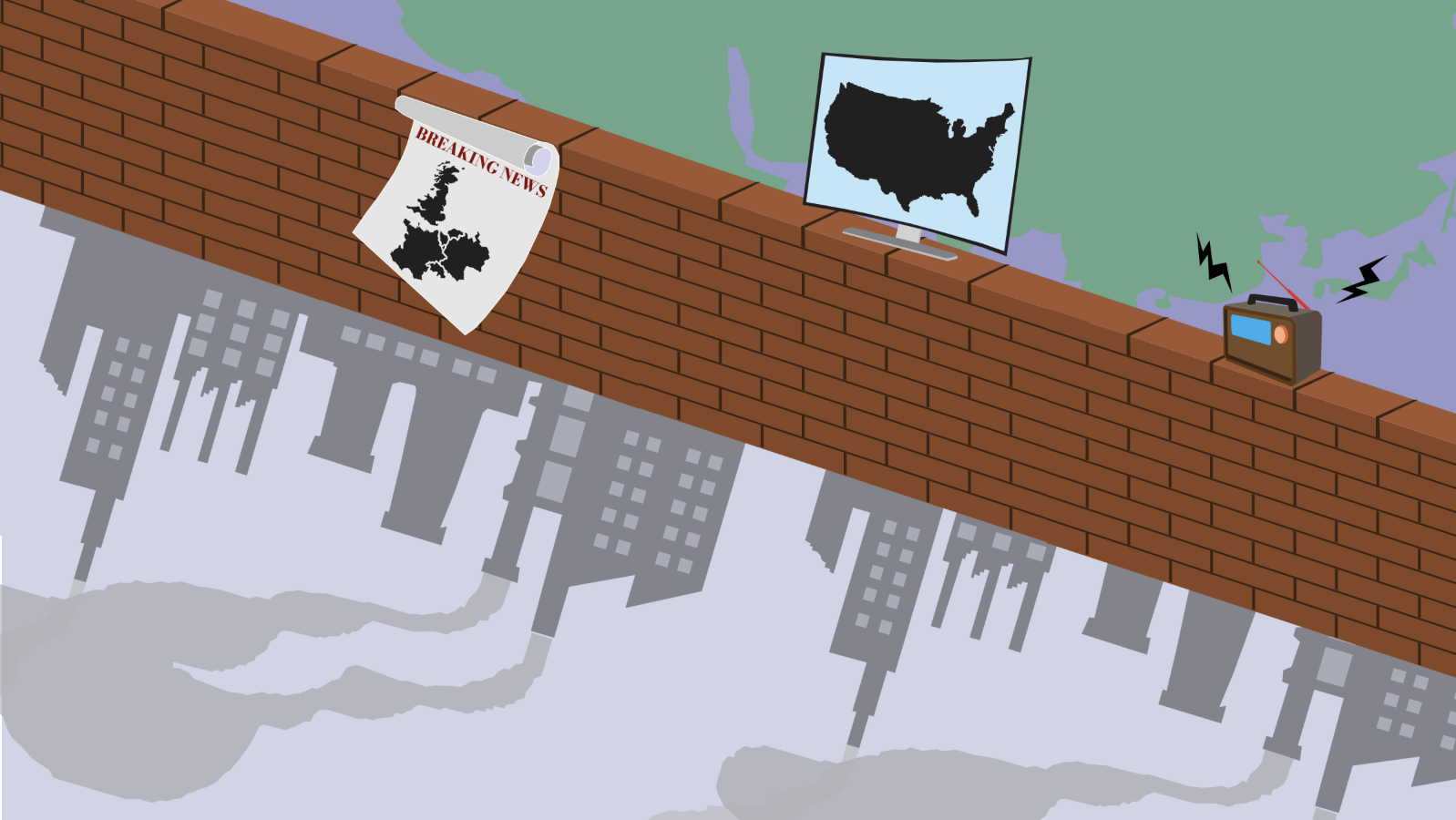
Design by Sheehan Banka
Sheehan Banka, Managing Editor
Let us begin with a traditional definition of the Western world as Canada, the United States of America, Australia, New Zealand, and a majority of the nations in Western Europe. Excluding Europe, these nations dominate the English language; including Europe, they share a longstanding history of industrial development. The transition from agricultural economies and human labor to mechanized production began in Great Britain, quickly crossing the English Channel and Atlantic Ocean to reach mainland Europe and the United States, respectively. By the beginning of the 20th century, industrialization — the precursor to all modern technology — had only spread to three powers outside this list: Russia, Japan, and the now-extinct Ottoman Empire. Since the era of industrialization, few countries have added their name to the "developed" column.
Today, the Venn diagram of Western countries and developed countries still forms a near-perfect circle, i.e., the two groups are almost one and the same. Thus, we can declare the following to be true: Most countries outside the West, a similar list to the world's developing or undeveloped powers, fall into neither circle. While not synonymous, these paired terms may be interchangeable for the duration of this piece.
The distinction between developed and undeveloped countries grows through the influence of Western media. Developed nations, with greater access to global outlets and technology, are more capable of promoting their worldview than that of a less technologically-advanced state. Neither view, of course, is entirely accurate; publicizing the international doctrines of any one nation is almost guaranteed to exclude the culture of another (see: Chimamanda Ngozi Adichie, "The Danger of a Single Story"). When Western nations spread their news to the masses as the driving powers of the world, they inevitably affect the omission of news from the developing world. This dichotomy exists as a self-fulfilling cycle: The growing influence of Western media pushes non-Western events in the opposite direction. Western news charges itself with loaded words that draw in viewers and garner public attention, pushing sensationalism over facts — the very definition of yellow journalism. In contrast, "foreign" affairs (those outside the West) are largely disregarded or, if noticed, then undermined.
No system, however, exists without exceptions. For an undeveloped nation, the most clear-cut path to media attention in the West seems to be discernibly opposing it. When Western outlets pan their attention away from the developed world, they usually turn to a country that poses an active threat to the sanctity of freedom and democracy (a concept often syncretized with the West, despite the representative democracies of large foreign states such as South Africa, Japan, India, and Brazil). Spy dispatches from Russia, North Korean nuclear tests, or alliances in the Middle East all generate higher numbers for our TV stations than, say, the three-year (and counting) Darfur genocide in Sudan. Even if a country is not trying to attract Western media outlets, press coverage will flock like drones to an enemy missile as long as they possess an ounce of evidence marking that state as a threat.
This selective representation is primarily due to the busy, rushed nature of Western life (itself an effect of the capitalist tenet to seek the most self-profiting decision; but that’s an article for another time). We push aside issues that don't immediately concern us in the name of efficiency, though this avoidance is more ignorant than pragmatic. Consider Afghanistan, a presently war-torn state and a prime subject of neglect under this “efficient” mindset.
The fundamentalist terrorist group known as the Taliban first captured the Afghan capital of Kabul in 1996. The United States (with a coalition of France, the U.K., Canada, etc.) did not intervene until 2001, once the Taliban became pertinent to the West through the attacks of September 11th. Two decades later, U.S. troops withdrew in exchange for the Taliban’s word to comply with counterterrorism measures, which the U.S. has made few and futile attempts to enforce. The Taliban has made a plethora of appearances on the Human Rights Watch since 2021, only this time without Western invaders to counter their atrocities against Afghan civilians.
In light of this exposure, many people disinterested in political matters may believe this issue is not particularly relevant to them (ignoring that this statement evidences the “efficient” Western mindset). Unfortunately, media selectivity does not limit itself to political content, let alone the fact that any topic is vulnerable to politicization today with the flick of a finger. Think of your favorite band or artist’s most recent world tour. How much of the world did they truly cover? Chances are, not a lot. Strict censorship policies or unsafe conditions explain the avoidance of certain countries such as China and many African states, though that still leaves a number of populated, relatively accessible nations like Brazil and India frequently ignored. Even in Europe, by far the most popular continent for performers, they tend to skip over the less prominent nations of the east, such as Greece and Türkiye. These locations usually only see action from locals or from residents of other countries outside the West.
The exclusion of Third World events from Western media, unless involving the West, dates back to the colonial era, when the earliest publications of mass media took the form of popular literature. In his essay “An Image of Africa,” Nigerian author Chinua Achebe examines Joseph Conrad’s racist depiction of native Africans in the iconic 1899 novella Heart of Darkness. The novella, set in the Belgian Congo during the Scramble for Africa, overemphasizes the perceived savagery of native customs, dehumanizing a medley of races as mere “limbs or rolling eyes.” Achebe notes how the idea of Africans working alongside European colonists unsettles Conrad, who goes so far as to call a native man overseeing the boiler of his ship a “dog in a parody of breeches.” Heart of Darkness is remiss of passages detailing the centuries of native food, dress, or language — you name it — because those aspects of African life do not fall in line with the policies of British or Belgian colonialism. In fact, the novella only contains two instances of natives delivering intelligible speech: once to depict the culture of cannibalism (in accordance with Conrad’s portrayal of natives as savages), and once to announce the demise of Mr. Kurtz, a corrupt, racist ivory trader and the novella’s antagonist.
This phenomenon has only grown from its historiographical beginnings. In the present day, the underrepresentation of non-Western countries infiltrates not just our art and politics, but our daily speech and local weather reports. When a tropical storm develops in the Indian Ocean, we dub it a cyclone. Over the Western Pacific, we call it a typhoon. When was the last time a “cyclone” or “typhoon” attracted strong national attention in the U.S. or Europe? The West is yet to gain extensive traction for raising public awareness of foreign plights in the wake of a natural disaster. In other words, cyclones and typhoons are just another blip on our maps until they bring their destruction to the Eastern Pacific or North Atlantic, where they run the risk of becoming a hurricane — the term more familiar to us in the West.
There are plenty of academic and artistic fields that highlight this system. Take the popularity of the Pulitzers and English-language Bookers over the Miguel de Cervantes or Caine Prizes, the portmanteaus of "Hollywood" in so many countries with decades of unique, endemic filmography, or the erasure of ancient Asian scholars like Baudhayana and Pingala, whose scientific and mathematical contributions populate elementary textbooks under European names.
Whether it be through politics, entertainment, literature, or any other medium, Western news outlets and publications inescapably shift their consumers' attention away from the happenings of the less-developed world. Thanks to these public messengers, it is significantly easier to regard a sector of the planet as wholly uneventful, given that it is personally unimpactful. I opened The New York Times list of articles on "Developing Countries" today, and six of the first seven entries (ranging from Jan. 15, 2026, to Nov. 20, 2025) to greet me mentioned China, Russia, or the United States. It is important to note that these sources are not necessarily at fault; the societal aspects of the West have simply caused its media to develop and institutionalize this mindset.
Eradicating the disparity between the West and the rest of the world is impossible; full equality is only present in a work of fiction known as Utopia. However, it is never too late to begin working our way toward that asymptote — unreachable, but always approachable. By reading about cultures that contrast our own, by caring about events that don't directly impact us, and by taking the time to address the circumstances and honor the contributions of every nation in the world, we can open ourselves up to a path of mutual progress that does not undermine the plights of any state. Internationalism supersedes a mere political definition; cooperation can germinate at a social, artistic, or scientific level. Five minutes a day is enough to unshackle yourself from the chains of media that keep us safe, comfortable, and out of the know. With exposure comes education, and with education can come a voice, a change, a call for action. Little by little, we can chip away at the blocks building up this Western wall.