
A new way to news
We need happier news in our lives
Design by Milo Park
Milo Park, Features Editor
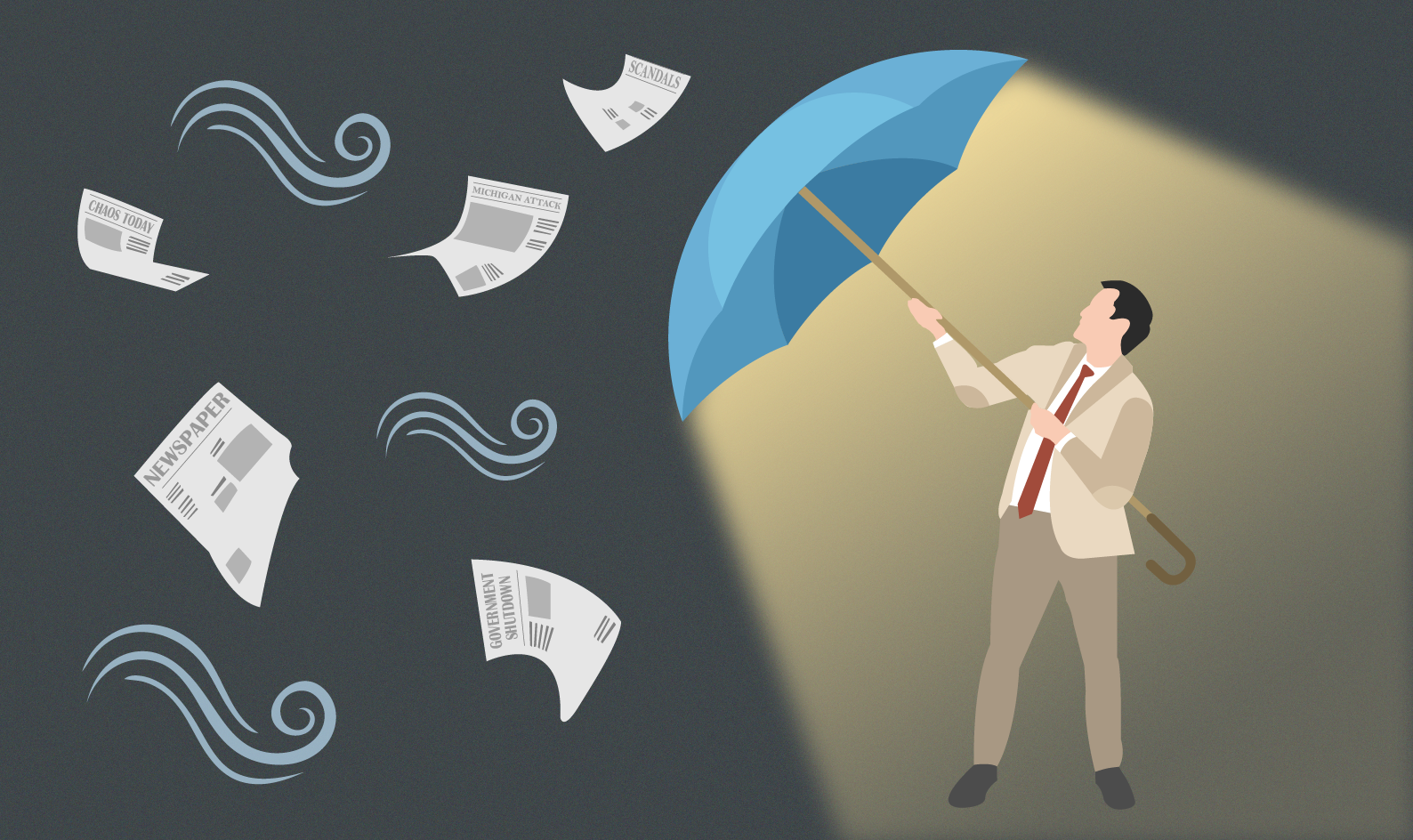
I challenge you to open your phone right now and scroll through the news. CNN, NBC, AP News, New York Times, Fox, whichever it may be. I'll bet you that the top stories are a mix of wars, scandals, disasters, or dramatic revelations of corruption, with maybe one or two pieces of "happier" news (if you're lucky). I'll even do it with you. "The government shutdown is a slow-boil political crisis", "As outrage over the war in Gaza grows, Europe's relationship with Israel falters", "Michigan church attack leaves at least 4 dead", it's a whole mess of negativity. It almost seems like the world is going to end every single day with mass-produced, sensationalized news, and it all starts to blur together.
Of course, journalism should cover serious issues that we as a society face, but in many cases, the constant flood of negativity can feel less informative and more stressful. It gets to a point where world news becomes an endless list of what we should panic about next, which often causes a tremendous amount of stress for countless people. To nobody's surprise, social media and online platforms have been a massive facilitator for the spread of this news to millions. A 2024 survey from AP-NORC found that 65% of American adults felt they needed to limit their political media consumption, and 45% felt they needed to limit media about the economy and jobs, both of which are commonly sensationalized topics in the news today. If over half of adults, regardless of political affiliation, say that the news is too overwhelming for them, just imagine what it feels like for teenagers and younger children who arguably engage even more with the internet and its gloom.
However, it goes beyond just the temporary souring of one's mood as a result of constant exposure to this bleak news landscape. There are real consequences to constantly reading about the seemingly imminent peril of the world. A steady diet of negativity can feed into polarization, eroding trust in institutions and weaponizing differences instead of emphasizing commonalities between people with different interests and beliefs. On top of that, a report from the American Academy of Child & Adolescent Psychiatry found that chronic and persistent exposure to media violence in children and adolescents can lead to fear, desensitization, and sometimes aggressive behavior. These are real effects that can impact our everyday lives regardless of age and background. They directly break down our social systems, threatening the livelihoods of future generations.
News outlets are not accidentally negative either. It is by design. It's important for us to realize that sensationalized stories generate more clicks, and more clicks mean more ad revenue for these publications. It's almost pure fact that a headline about political mayhem or the latest scandal will outperform one about a new scientific innovation or any generally positive milestone that humans achieve. Big news outlets deliberately formulate the system to shock readers with flashy headlines and buzzwords that may sometimes strongly exaggerate the actual news within the article. This extremely selfish model traps people in a cycle of pessimism without them even realizing it, making awareness more important than ever.
Changing the system is difficult. It is unlikely for every single media company to alter its click-chasing methods, especially with the sheer number of outlets and the vastly varying viewpoints of each publication, each with its own political, ideological, and religious perspectives. But what we can change is the way we consume the news. Instead of clicking the loudest, most shocking stories out of impulse and curiosity, we can work to be more intentional about what we read. It's clear that many news outlets care more about your click than your mental well-being, so you should be the strongest advocate in consuming news in a healthier way. Before reading the most flashy article, we can evaluate if the news comes from a credible source, determine if there is room for dramatization of the news, and think twice before clicking on a headline. By opting to read from balanced sources, engaging with stories that highlight solutions and hope, and taking well-deserved breaks from the negativity, we can build a healthier news diet for ourselves—one that nourishes us instead of draining us.