
Faceoff: AI art
Is AI art real art?
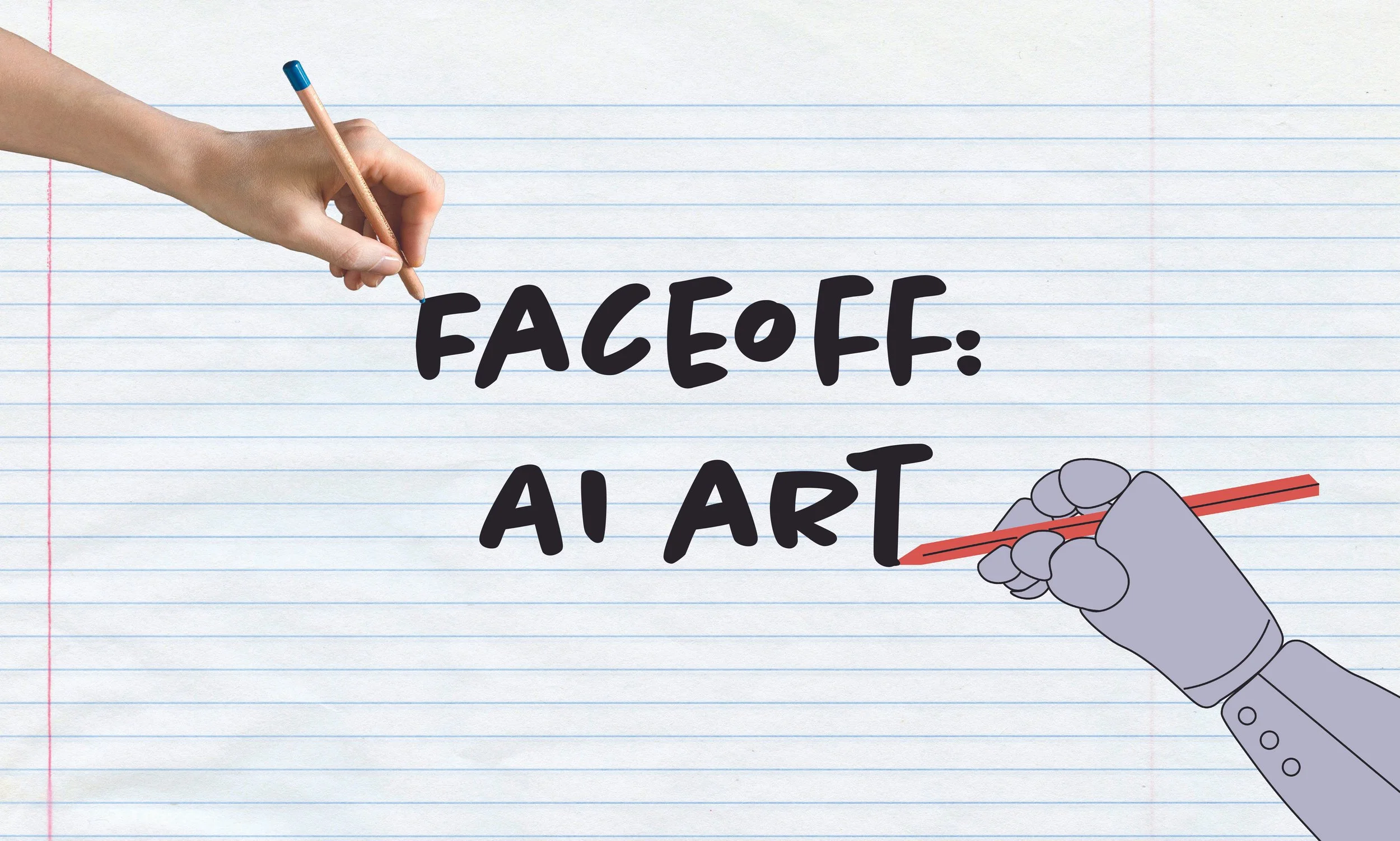
Design by Claire Wang and Zulfah Muzammil
Yes
Claire Wang, Managing Editor
In order to argue whether art created by artificial intelligence (AI) is "real" art, we must first define the term. The Oxford English Dictionary defines art as "the expression or application of human creative skill and imagination, typically in a visual form such as painting or sculpture, producing works to be appreciated primarily for their beauty or emotional power."
AI cleanly fits into these parameters. To get the obvious out of the way, AI art is a visual medium and is generally made for its beauty or emotional power. Therefore, AI art fulfills these two conditions. AI art is also an outlet for human creative expression, as the AI generates the art in response to a human-written prompt. These prompts require imagination and skill, as the human must write clear, detailed instructions depicting the scene in their mind's eye. Thus, AI art fits the definition for art and is, in a way, "real" art.
Detractors of AI art often argue, however, that the quality of being "real" in regards to art consists of more than a definition. To them, AI art is poor quality and soulless. I would argue otherwise. AI is constantly improving. When comparing images generated in Jan. 2021 to images generated in the current day, the difference is incredible. Nowadays, AI can create abstract and stylized art almost flawlessly. Extra fingers and wonky pupils are a thing of the past for skilled creators. Many people have trouble distinguishing AI art from human-created art, and it will only improve from here.
The argument that AI art is soulless — that it's thoughtless and unfeeling — is also easy to disprove. AI art, contrary to popular belief, can take time, effort, and care to create. Human involvement is present throughout the entire process. AI cannot read our minds, and it can be challenging to translate an exact image from the mind into words.
Imagine a prompt that says, "Create an image with a couple overlooking a mountainous landscape at sunrise." There are practically infinite ways one can interpret this prompt. Let's say I'd prefer there to be a light mist over the landscape. I add the instruction to the prompt, and now the entire image is hazy. That's not what I wanted. And honestly, those mountains are a little too rocky for my tastes. I was picturing more of a lush, jungle-like vibe. I add that to the prompt, and all of a sudden, the mountains are looking more like hills. Actually, the couple is too close to the camera and too detailed, and the sunrise really looks more like midday, and the clothes they're wearing don't fit the image, and a million other problems.
All of these issues require careful tweaking involving prompt weights, positive and negative prompts, and tons of other prompting jargon that requires skill and knowledge to master. AI is the tool that humans use to bring the art in their minds to life, and that, to me, proves that AI art has soul.
No
Zulfah Muzammil, Staff Writer
Art could be a painting with a vase of flowers. It could be a sculpture of a loved one. It could even be a banana taped on the wall with grey duct tape. Art can be anything you want it to be. It is a reflection of life. No one is to decide if something is art or not. Art is subjective. Art is all in the expression or application of human creative skill. But what makes art, art? Art takes a human mind to think, process, and feel emotions, ultimately prompting them to create or express these feelings in their own way, making the different types of art emerge. It's a given that not all art will look the same, except one type: art made by artificial intelligence (AI) as it replaces human talent and lacks the ability to create original images.
AI art is all identical. There is no thinking, emotion, or humanity behind the creation. AI generates images without a second thought. It's all uniform and repetitive with slight disfigurement. It's always easy to spot AI art, as there is always something uncanny. For example, there would be an extra hand or an extra leg in its portraits, or just an unnatural look to it. However, I do understand the appeal to AI art. People seek AI-generated images because they are customizable, convenient, and cost-free. It's like a helping hand in projects when you feel the fatigue kicking in. But why should we resort to AI when we have artists who have worked for years on their craft? The years of hard work and honing your skills would go to waste.
Even if AI has the ability to make quick images, it does not have one thing: originality. AI lacks the skill to make an original image, so it gathers several pieces of work from multiple artists. It's simply a form of plagiarism. Taking inspiration from other artists is one thing, but taking others' work is another. AI-generated images can be artistic but never true art. Programmed robotic software can never be the same as the work of a human being, full of emotions and life.
Why would the art of a bunch of 0s and 1s be better than that of a human being? Human art tells a story, while AI art has nothing to tell.