

Proof of recovery
Recognizing successful conservation efforts from around the world
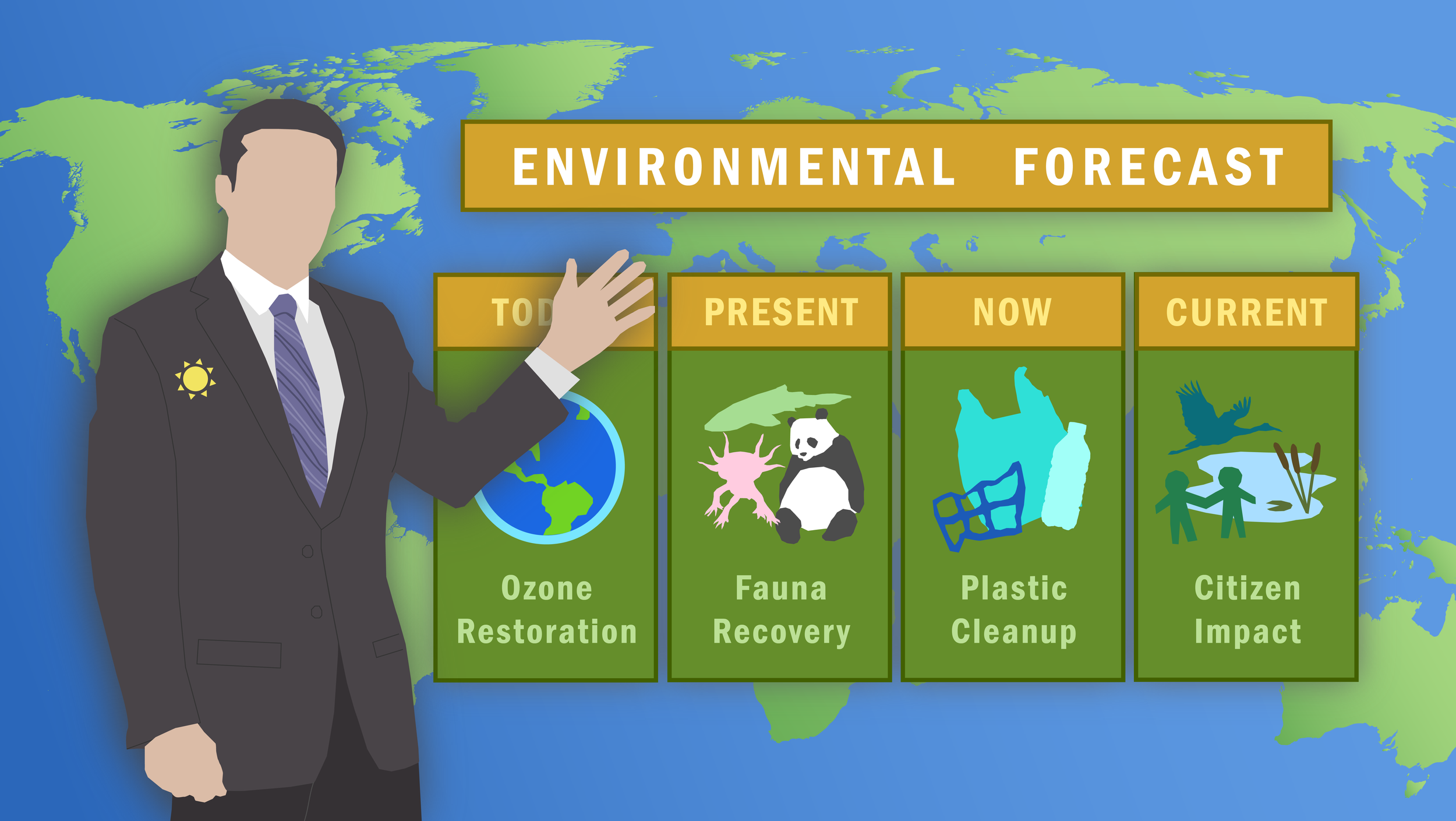
Design by Milo Park
Milo Park, Features Editor, Sheehan Banka, Managing Editor, & Rhea Taneja, Staff Writer
"The earth is dying."
"Ice caps are melting."
"Global temperatures are at an all-time high."
Statements like these, albeit truthful, project a negative connotation for the environment of our planet. When thrown around in media, they can induce symptoms of anxiety and depression.
While staying educated on environmental issues is crucial to societal growth, it can be easy to lose track of the positive changes in our ecosystems. Conservation projects across the globe are replenishing marine biomes, restoring endangered populations of flora and fauna, and promoting eco-friendly tourism. Both government policies and civilian organizations demonstrate a growing concern for the health and safety of the planet.
Perhaps the most impactful environmental issue of this century has been the rapid depletion of the ozone layer, the section of Earth's atmosphere that reduces greenhouse gases by absorbing a majority of the sun's ultra-deadly ultraviolet radiation. Following the Montreal Protocol of 1987—the first treaty to receive unanimous ratification in the United Nations—every member of the UN has implemented plans to phase out their usage of ozone-depleting substances such as chlorofluorocarbons, or CFCs. When released into the stratosphere, these small compounds react with and rapidly destroy ozone molecules. A 2023 report by the UN Environment Programme (UNEP) asserts that nearly 99% of ozone-depleting substances had phased out by the 2020s. The late 20th and early 21st centuries saw the formation of an "ozone hole" more than twice the size of Europe. This report, however, predicts that the ozone layer will be as strong in 2040 as it was in 1980, prior to the formation of the hole. UNEP expects a full recovery by 2066, and a 2024 article by NASA corroborates this estimate.
As a catalyst for international cooperation, ecological protection initiatives can supersede even the strongest of political rivalries. On the border of North and South Korea, there lies a buffer zone known as the Demilitarized Zone (DMZ). Regulations in this borderland prevent either country from bringing a large stock of military officers or weapons. However, both nations retain landmines in the DMZ planted well before its formation in the 20th century. For this reason, the DMZ has remained a relatively untraversed region, where human activity is not a major disturbance to nature. As a result, this narrow strip of land has become a tiny hotspot for biodiversity, playing host to nearly six thousand species, over 100 of which, like the Amur leopard and Siberian tiger, are endangered. Neither North Korea nor South Korea has engaged in serious attempts to disrupt this oasis of wildlife. To further ensure the safety of the species in the DMZ, numerous university studies have advocated for the region to become officially protected as a biosphere reserve under the UN Educational, Scientific and Cultural Organization, or UNESCO. The destruction of a UNESCO World Heritage Site is punishable as a war crime under international law. This has severely disincentivized most ecoterrorism, a powerful step forward for biodiversity conservation.
However, not every conservation effort requires international treaties or severe legal action; some succeed through sheer human collaboration. Lake Poyang, China's largest freshwater lake, is a wetland of national and global importance, appropriately nicknamed "a land of abundance." The lake's rich biodiversity and flourishing crops make it a prime rest stop for thousands of cranes, storks, pelicans, and other birds migrating to warmer climates in the winter. The lake, which was nearly dried up in 2012, is today the site of a remarkably successful restoration effort. Habitat fragmentation from years of pollution and overfishing caused a decline in Lake Poyang's water quality, threatening endemic species as well as the 45 million residents of Jiangxi province. Fortunately, recent civilian action has reversed much of this damage. Citizens petitioned for government intervention and asked various conservation groups and their local communities to join the initiative in protecting this principal body of water from further pollution. Groundbreaking improvements happened in the lake's water quality and biodiversity. This restoration project brings back keystone species alongside human benefits, such as fresher drinking water and a variety of vitamin-rich fish. The lake's touristic scene has also seen its own growth as visitors flock to an ecological wonder. The protection of this integral piece of our ecosystem demonstrates the large-scale impacts that a small cleanup initiative can have with a little group effort and commitment.
Habitat loss doesn't stop at fish or birds. Both aquatic and terrestrial fauna are vulnerable to the dangers of human industry, such as poaching, deforestation, and fishing lines. To protect species at risk of extinction, the United States passed the Endangered Species Act (ESA) in 1973. According to the World Wildlife Fund, the ESA is history's most successful piece of ecological legislation as they state, "99% of species listed on it have avoided extinction." One of the most recent species to bounce back from the brink of extinction is the green sea turtle, which jumped from Endangered to Least Concern on the IUCN Red List in October 2025. Beach-site protection zones and marine plastic removal have greatly reduced the number of man-made factors threatening this species in the waters around Brazil, Hawai'i, and Mexico.
At a global level, the Director of China's National Forestry and Grassland Administration reported a total of 808 pandas growing in captivity as of November 2025, which is a 6.7% increase from the previous year. Additionally, more than 1,200 of the approximately 1,864 pandas left in the wild are currently protected by federally-managed nature reserves or replenishing bamboo forests. Another species that has seen worldwide conservation successes is the axolotl. Every one of these salamanders with limb-regenerative abilities inhabits a single urban ecosystem: a series of endorheic waterways spanning Mexico City. A 2025 study under the National Library of Medicine confirmed the successful release of captive-bred axolotls into wild territory such as Lake Xochimilco. This means the creatures' primary threat has shifted from pollution and bad water quality to natural limiting factors like predation. Axolotls have also become an icon in many franchises of popular culture. The Pokémon Mudkip and Wooper are directly modeled after an axolotl, as is the dragon Toothless from How to Train Your Dragon. Even Minecraft added five different colors of axolotl in its 2021 Caves & Cliffs update. These media depictions have popularized the axolotl and raised awareness of its proximity to extinction, driving public support and involvement in conservation efforts.
It doesn't always take a national government or a multi-billion dollar company to help save a species. Former Northview student Adriana Bassett, now a Junior at Loganville High School, volunteers as a part-time public educator at the Georgia Aquarium, where both visitors and staff contribute to saving zebra shark populations.
"Inside [the aquarium], you can find zebra shark eggs everywhere," Bassett said. "We take these eggs and breed them in the safety...of the aquarium. Once they're older and ID'd and ready to go, we release them in Indonesia, where they naturally live."
In their native habitats, zebra sharks are functionally extinct, meaning their population is extremely low in numbers and subject to widespread human threats like bycatch (fish that unintentionally end up in a net) and the fin trade (popular for shark fin soup). Less than two dozen zebra sharks remain in the waters of Southeast Asia, restricted to the Indonesian archipelago of Raja Ampat. The Georgia Aquarium's ReShark initiative accepts visitor donations to help fund their restoration of zebra shark populations in collaboration with Indonesia's Stegostoma tigrinum Augmentation and Recovery Project, which protects indigenous leopard sharks.
"It's kind of sad that we have to [repopulate them], of course," Bassett said, "but I like to think about how much we're able to help wherever we can...and it's been really successful. We have new people and [technology] helping us learn more about certain species [to] reduce the threats they face in the ocean."
One of the largest threats to aquatic life is the prevalence of plastic and other trash polluting the world's oceans. Organizations like The Ocean Cleanup, founded by 16-year-old Boyan Slat in 2013, have worked endlessly to rid waters of manmade pollutants. In just over a decade, Salat's nonprofit has extracted and recycled more than 20 million kilograms of trash and implemented nearly half a dozen trash interceptors in bodies of water across the globe. With the motto "We aim to put ourselves out of business" gleaming on their website, The Ocean Cleanup is well on its way to eradicating 90 percent of the world's floating ocean plastic by 2040.
Oftentimes, large-scale restoration & conservation projects and international treaties dominate environmental headlines, but some of the most tangible progress begins with everyday civilians at the local level. At Northview High School, that work is already underway with efforts from the student-run Earth Allies Wildlife Conservation Club, led by Sophomore Ethan Mathrani. Their efforts have planted roughly 100 trees across Shakerag and Cauley Creek Parks within a single year, directly increasing canopy cover and long-term carbon sequestration. The club has also raised approximately $2,000 for local veterinary clinics during winter months, when there are less opportunities for outdoor restoration. According to Mathrani, these projects begin with local and community involvement.
"That's how we got permission for planting the trees in the parks," Mathrani said. "We went [to the mayor's office], and they granted us that permission."
This process mirrors the same civic and governmental mechanisms that allow national conservation policies to come into play, reflecting a general truth seen in many of the world's most successful conservation efforts: Environmental recovery and preservation often rely not only on governments or scientists but also on ordinary people who choose to take initiative.
That exact ideology, Mathrani says, should encourage everyone to take action, even from the comfort of their own homes. Outside of school, he maintains a small bird-feeding station; grows everything from fruits and vegetables to flowers for pollinators in his garden; and uses a homemade three-layer vermicomposting system to minimize waste ending up in landfills. Mathrani also makes a point to minimize plastic use and rely on reusable bags and natural household products, all of which can limit synthetic waste from entering local waterways and the natural ecosystem. With this, Mathrani puts emphasis on just how easy it can be to participate in conservation efforts to help the planet.
"You could start off by literally throwing your wrappers in the trash," Mathrani said.
Examples such as these from around the world — the repopulation of zebra sharks, the gradual closing of the ozone hole, the removal of more than 20 million kilograms of plastic from the ocean — suggest that environmental recovery is achievable through a pattern of changes. Although personal awareness is the first step anyone can take to contribute the ongoing restoration efforts, what also matters just as much is how often and how effectively people, organizations, and communities choose to actively participate in the environment's repair. The preservation of the planet is a collective responsibility, and everyone plays a role in its success, whether it be through funding, labor, education, or initiative.
"I love getting to talk to people about all the different species we protect," Bassett said. "Hopefully there'll be more people getting involved and interested to help. [They] keep nature, and the world, running safely."