
More than a dance: Garba
What Garba means to the Hindu community
Design by Ridhi Boggavarapu, Rhea Taneja, and Zulfah Muzammil
Ridhi Boggavarapu, News & Copy Editor, Rhea Taneja, Staff Writer, & Zulfah Muzammil, Staff Writer
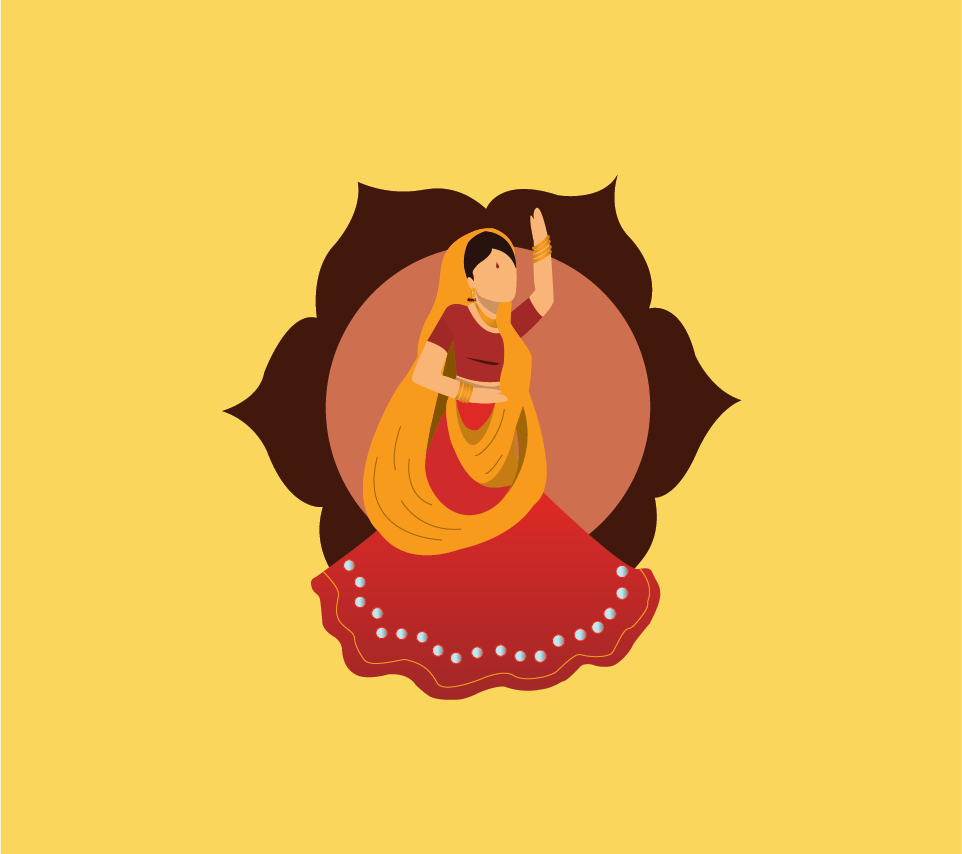
Garba: the festival of dance. Circles of dancers form as the music starts to play. The clinking of anklets, the rhythmic tapping of feet against the ground, the swishing of lehengas, the light of the lamps reflecting off the intricate mirror designs on the garments—it all has a way of making you feel truly alive. It's exciting, it's inviting, and the energy is infectious. But what exactly is Garba, and why does it matter?
Garba is a form of traditional dance originating from Gujarat, a state in the western part of India. It takes place during Navratri, the nine-day-long Hindu festival dedicated to Goddess Durga. Many people often fast, or are on a special diet, only eating specific foods during these nine nights. This form of dance celebrates the power of the feminine side of the divine. It honors the Goddess and the qualities that they represent. Traditionally, women perform the dance in a circle around a clay lantern with a light inside, known as the Garbha Deep ("womb lamp"). The dance around the lamp symbolizes how divine energy is within everyone. Everyone does the dance barefoot as a sign of respect for Earth and the land they walk on. Many believe this practice also helps them connect with God.
Today, people from all over the world celebrate Garba, including within our Northview community. Both Hindus and non-Hindus alike join the festivities. Garba unites people and spreads joy and excitement. It also signifies the strong cultural appreciation permeating throughout Northview and our local community.
"I think it's a great way [for others] to explore new cultures, new foods, new clothing," said Aanya Jagavkar, President of Northview's South Asian Student Association (SASA).
"It's systematic, it's rhythmic. I think it brings in a lot of energy more than anything else. And that whole vibe... And no matter when you come in, you're all in sync. I think that has a lot of power that gravitates everyone to come to these events," said Ms. Anu Bhardwaj, teacher at Northview.
However, Garba is only one of the many types of traditions done across India during Navratri. Navratri is nine days of worship to the goddess, Durga, who has nine divine feminine forms, each representing certain qualities. Hence, this ritual takes place over the span of nine days. In the northern part of India, people perform a special ritual called Kanya Puja, where during the eighth and ninth days, young girls dress up as one of the nine forms of Goddess Durga, and others in their community worship them as the girls are thought to embody or represent Durga, and are offered clothes and food. In Southern India, Hindus celebrate Navratri with the Kolu/Golu, an exhibition of dolls and figurines arranged in stepped displays, often depicting deities. Various states, regions, and even families have different traditions passed down through generations. Although the traditions greatly vary, the sentiment and significance remain the same--honoring Goddess Durga and good triumphing over evil.
Some ways that people in Northview's community commemorate this religious event include following a special fast, doing daily prayers, and participating in community-based activities such as Garba. Many Hindus perform fasts where they refrain from consuming non-vegetarian food items and only consume sattvic — or foods considered pure, such as fruits, milk, and vegetables. However, some families take this a step further by adding structure to their fasts.
“You always fast for two days. It has to be an even number. It cannot be an odd number,” Mrs. Bhardwaj said.
She explained that her mom would fast either the first and last days or the first two days. Daily prayers, or puja, play a vital part in the Navratri celebrations as devotees perform Aarti, offering flowers, lighting incense, lamps, and offering food to the different forms of the Goddess Durga.
Others have symbolic ways to mark the nine days of Navratri and the nine forms of Durga. Each of the nine forms of Durga represents a different aspect of divine feminine energy. From innocence and purity to fierceness and destruction of darkness, the nine forms signify the diversity of feminine power. To represent these nine forms, people often use color.
"My mom, she wears saris every day, designated to a certain color [for each day] during Navratri," said Rishi Sharma, president of Hindu Yuva, a club that protects, promotes, and practices Hindu culture at Northview.
Overall, Garba acts as a symbol of unity and good defeating evil. It is more than a dance; it's a tradition dating back centuries, it's a reminder of the importance of staying virtuous, and it rejuvenates and strengthens the local community, both in India and beyond.