

Kate and the sky
A Broadway actress' journey and message for the world
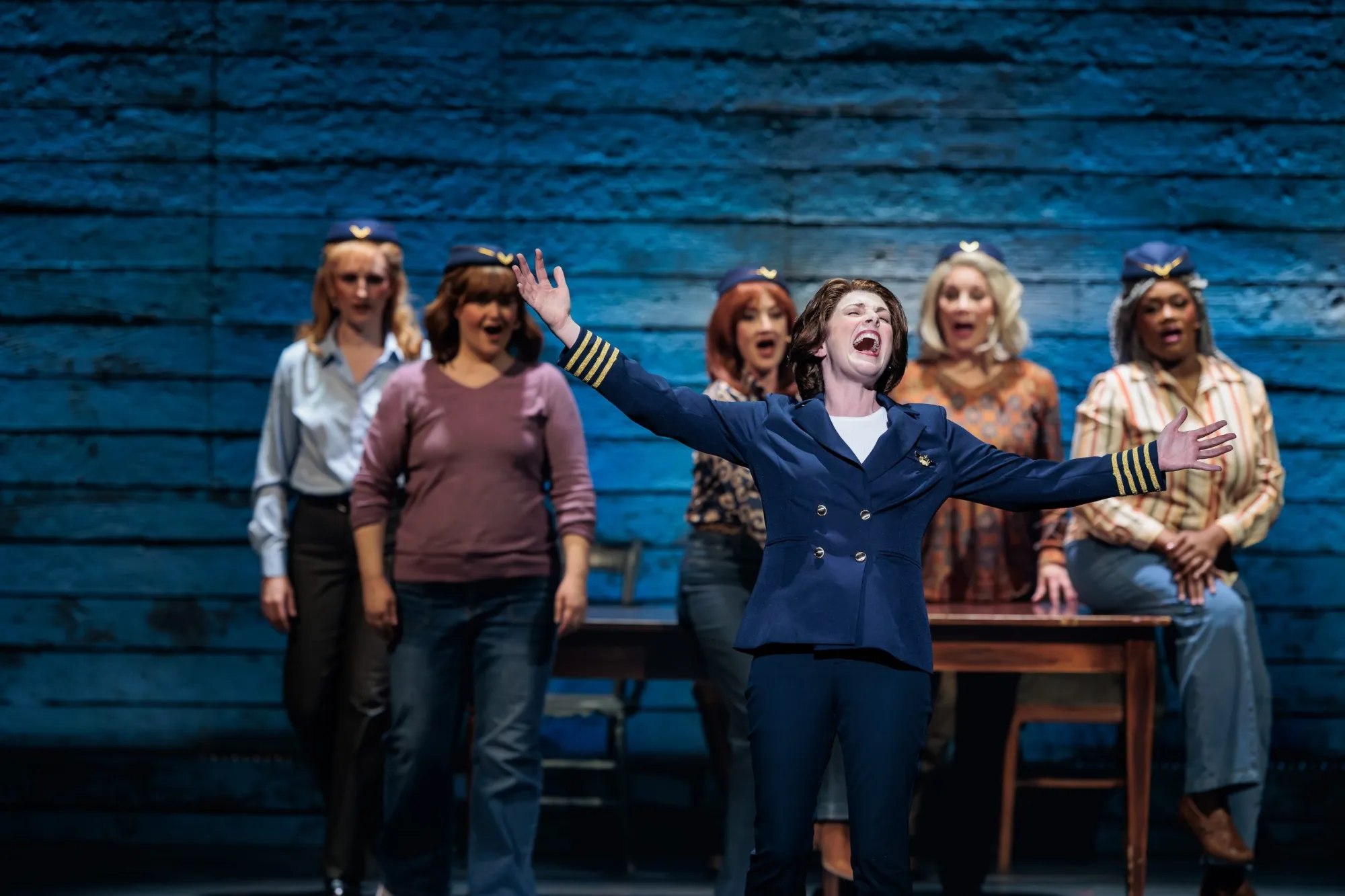
Photo courtesy of Ben Rose
Sheehan Banka, Managing Editor
She was three years old when a passerby on the sidewalk handed her a flyer for a dance studio. She rushed to her mother, flyer in hand, and soon enough, began to dance.
A decade passed. She was barely a teenager when a series of eye-opening events introduced her to the world of musical theater, the subject she would eventually study in college.
She was a freshman in high school when she first auditioned for her school’s show choir. Despite an initial rejection, she persisted in her pursuit of a spot on the stage. She continued to sing.
She made it into the school musical that same year, landing a spot in her very first production: “The Music Man.” This was not a one-off feat; there was no “beginner’s luck” involved. She made it into the musical all four years of her high school career, alongside a senior-year role in the play “Up the Down Staircase.”
After a brief time at college, she left for New York. She was 20 years old when she embarked on her first National Tour, playing Demeter in “Cats.” Since then, she has performed in over 30 different shows. Her roles have ranged from Glinda in “Wicked” to the eponymous “Evita” Perón. Her stages have ranged from Philadelphia’s Walnut Street Theatre to the venues of Broadway.
Her name is Kate Fahrner.
This March, she played Beverley Bass in the City Springs Theatre Company’s Regional Premiere of “Come From Away.”
This is her story—and the story of a small town “on the edge of the world” that nearly doubled its population overnight.
This is the story of a community that brought peace and love in a time of darkness and despair.
This is a message—from Kate Fahrner, and from the residents of Gander, Newfoundland—to restore our faith in humanity.
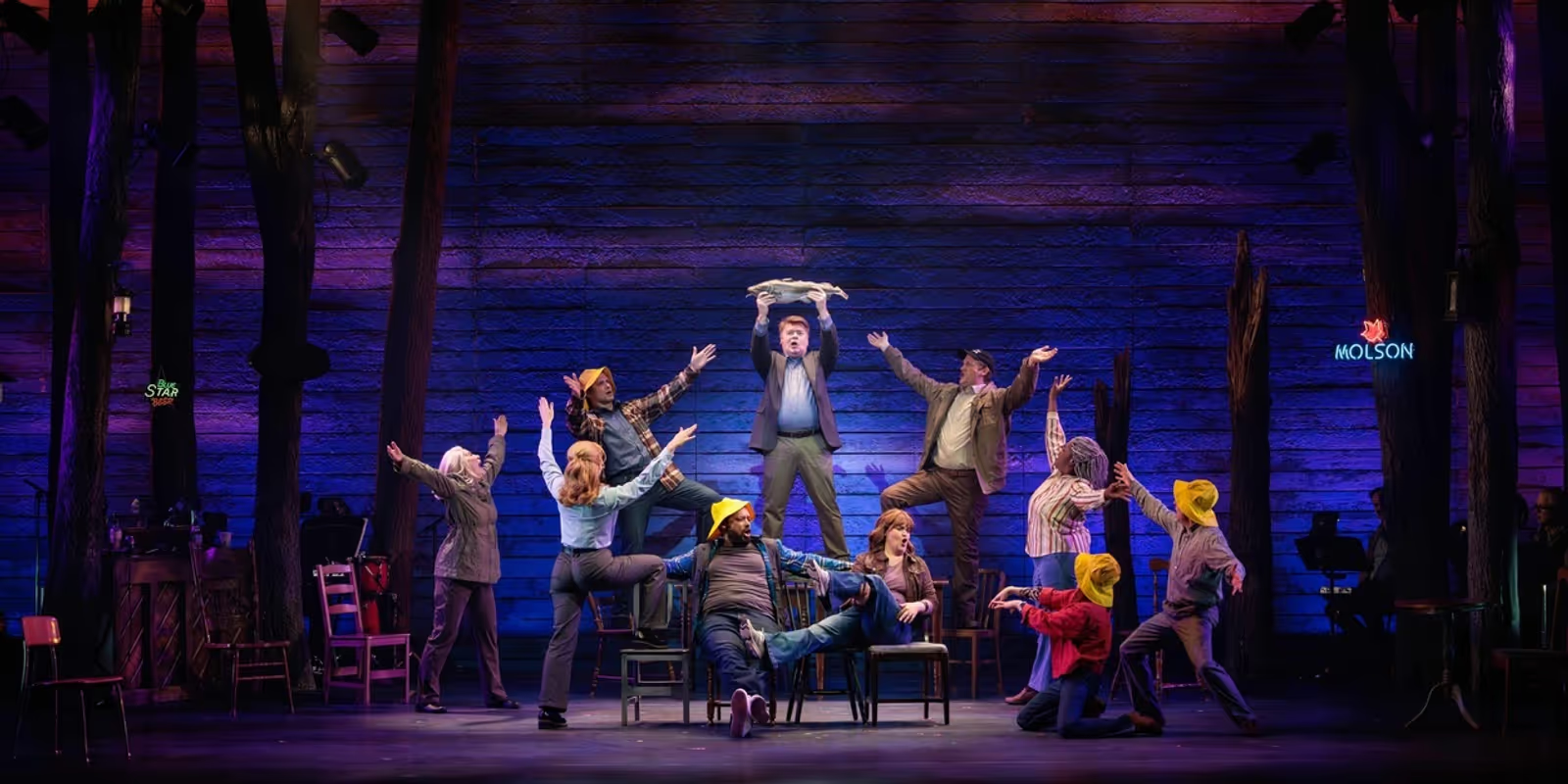
The cast of "Come From Away" at the City Springs Theatre Company play both Newfoundlanders and plane passengers.
Photo by Ben Rose.
Raised in a small Michigan village, Fahrner grew up with dreams of becoming a Shamu trainer. Aspiring to spend years swimming with the orcas at SeaWorld, she never expected the profession that eventually drew her in: musical theater.
Despite early indulgences in the performing arts, it wasn’t until a high school trip to see the National Tour of “Beauty and the Beast” in Detroit that Fahrner realized the potential of theater as a career option.
“As a child, I watched two movies all the time: ‘Gypsy’ and ‘A Chorus Line,’” she said, “but I remember the first time I saw a professional show. Before ‘Beauty and the Beast,’ I’m not even sure that I understood there were National Tours [or] that you can do this, you can do Broadway, professionally.”
Further trips to see “Rent” and “Phantom of the Opera” in Toronto with her mother only heightened Fahrner’s interest in theater, though she had not yet fleshed out her professional interest. When she initially applied to the University of Michigan, the school’s pull factors included not only a growing Department of Musical Theatre—today the top-ranked musical theatre program in the United States—but also the campus’ proximity to her home.
Fahrner’s turn-of-the-century high school introduction to theater contrasts heavily with today’s children, many of whom begin competing to land a role onstage from an early age. The 21st century has seen a significant increase in summer camps and extracurricular programs specifically dedicated to providing young children exposure through rehearsals and performances. These opportunities foster growth, but inevitably breed an unhealthy level of competition in a number of aspiring kids.
“The business of the theater community has changed a lot in the 25 years that I’ve been doing it,” Fahrner said. “There wasn’t social media like there is now. Now there’s 8 million schools and 8 million camps where people are starting [theater] when they’re 10 years old.”
Competition in theater drives many actors to dream of one day landing a role on Broadway, often viewed as the “final destination” for performers. The idolization of Broadway turns this high-achieving milestone into a necessity even for actors who have successful careers outside the lengthy New York City street.
“There’s a part of me that still thinks I haven’t made it yet because I wasn’t in the original company of a Broadway show,” Fahrner said, “and that’s absolutely ridiculous.”
Although she has yet to perform in an original Broadway cast, Fahrner worked on Broadway as the standby for Glinda in "Wicked" from August 2011 to November 2012, and has even played Glinda’s role. According to her, the transition from local theater and off-Broadway productions to Broadway is not a large one.
“The difference is really [how] I didn’t rehearse in a room with anybody from the cast, and then all of a sudden, I’m on stage with them,” she said. “When I joined the Broadway company, some people had been in it from the beginning, so you’re just kind of jumping into their day-to-day life…but it’s still all stages and costumes and sets.”
For Fahrner, the most enjoyable aspect of a show is the connection she makes with her castmates. The community development of regional theater allows her to discover new ideas with her fellow actors, an opportunity that Broadway shows often limit. Fahrner recounts an anecdote from “Come From Away” cast member Kyle Robert Carter about the intimate bonds that develop in regional shows.
“Kyle, who plays Captain Bristol, was saying ‘I wish we could do this show 300 times, ‘cause we could find 250 different versions of all those little scenes, and it would just be so fun,’” she said. “But that’s only if you get to do it together for all 300 of those times.”
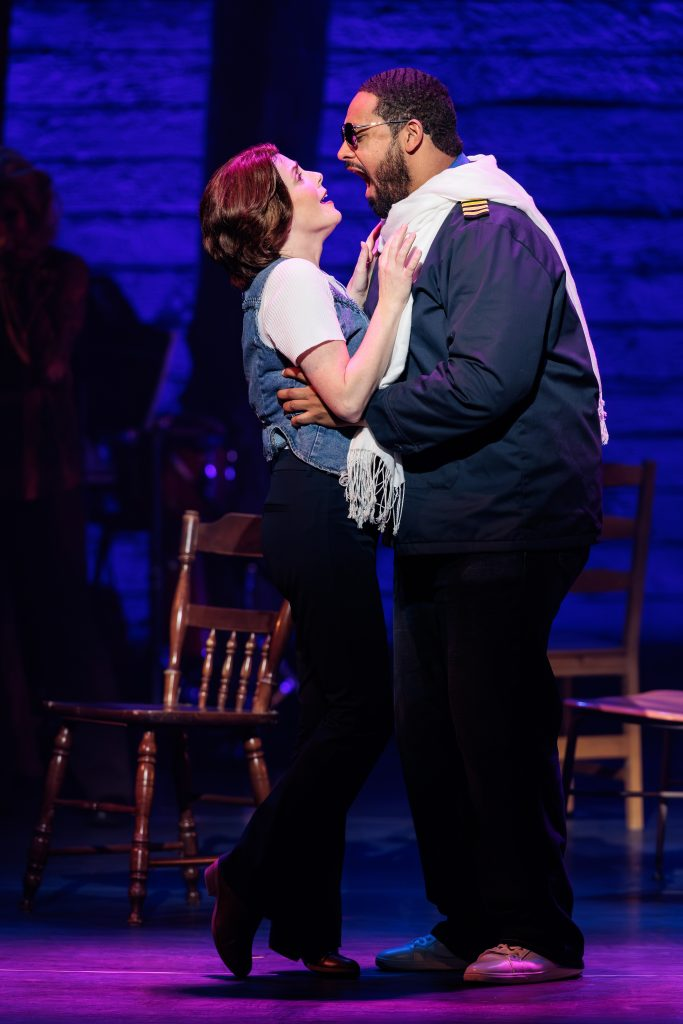
Fahrner (left) and Carter (right) act out an intimate moment between Beverley and Captain Bristol.
Photo by Ben Rose.
From March 13–29, 2026, Fahrner, Carter, and 12 others performed in the CSTC’s Regional Premiere of “Come From Away,” the first performance of the musical in the state of Georgia.
“Come From Away” follows the story of 38 planes diverted to Gander International Airport, once the largest airport in the world, near the eastern tip of Newfoundland, Canada. The diversions, executed under Operation Yellow Ribbon, began less than 20 minutes after a hijacked plane crashed into the South Tower of the World Trade Center on Sept. 11, 2001.
Gander’s population almost doubled overnight. The small Canadian town of about 10,000 people took in nearly 7,000 passengers and crewmembers as a result of the diversions, requiring quick thinking, unbounded hospitality, and a rapid collection of resources to accommodate people from all over the world.
Canadian composer-lyricists David Hein and Irene Sankoff wrote “Come From Away” over the course of three years, completing the libretto in 2013. In 2011, on the ten-year anniversary of the terrorist attacks, the couple spent a month in Gander to interview some of its residents regarding their experiences in the days following the diversions. These interviews helped establish the historical realism of the interactions between the “plane people” (as the Newfoundlanders refer to them in the show) and the residents of Gander.
The twelve principal actors of “Come From Away” each have a minimum of two roles: one as a member of the “plane people” and one as a civilian in Gander. In the CSTC production, Fahrner played Annette, a Gander schoolteacher who models the warm, welcoming attitudes of the townspeople, as well as Beverley Bass, the real-life pilot of the 36th flight diverted to Gander on 9/11.
In 1986, Bass made history as the first female captain of a commercial plane flying for American Airlines. The pilot recounts her journey to this milestone, as well as her experiences leading up to the day of Sept. 11, 2001, in one of the musical’s most climactic numbers, “Me and the Sky.”
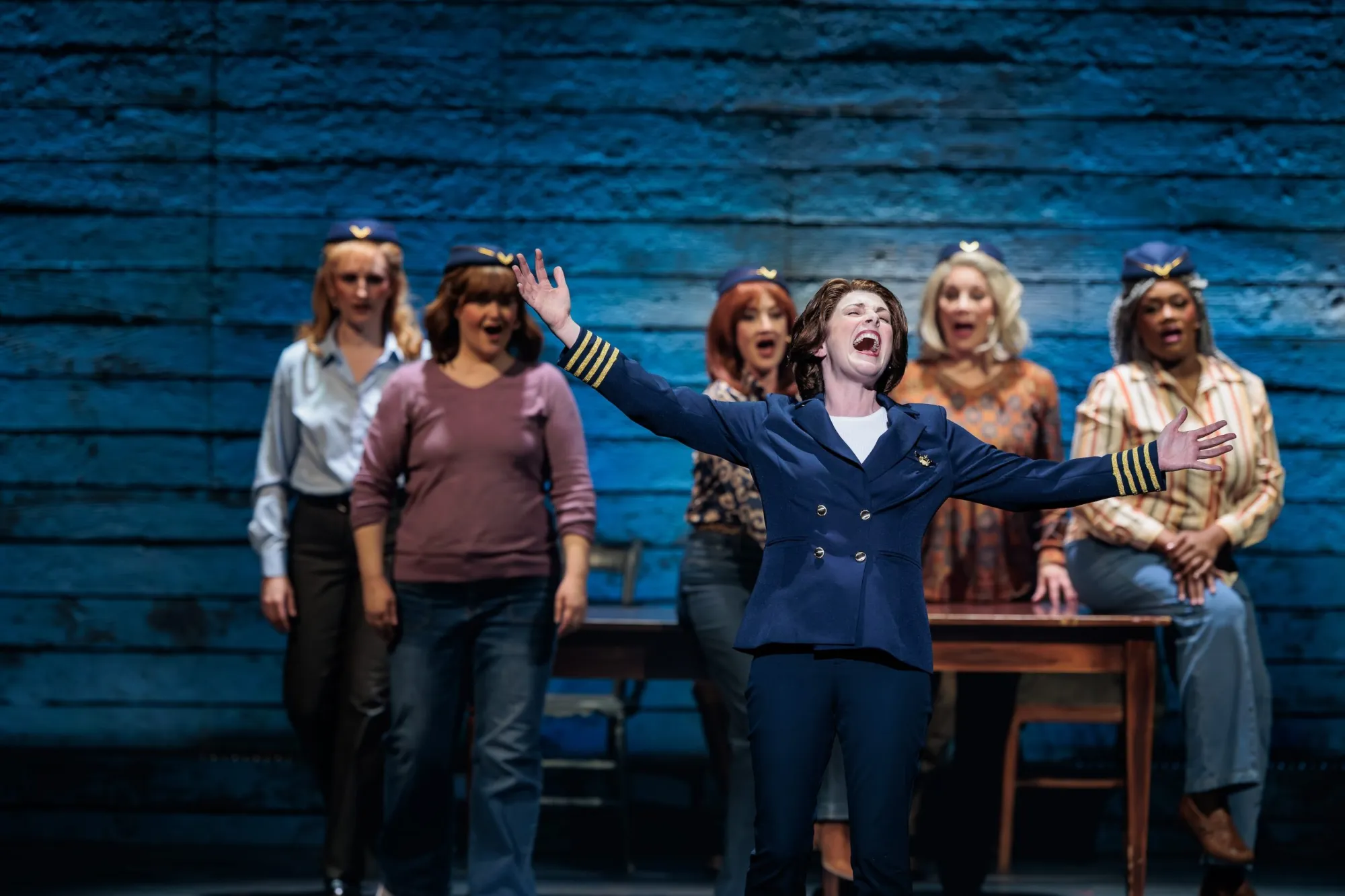
Fahrner, as Beverley, recounts breaking through the glass ceiling in the number "Me and the Sky."
Photo by Ben Rose.
“Me and the Sky” paints an emotional picture of Bass’ struggle as an up-and-coming female pilot in the latter half of the twentieth century, when “there were no female captains” and the male pilots dismissed her as being “too young and too short.” In the song, Bass’ character explains how neither her fellow pilots nor the stewardesses treated her with respect during her initial application to work as a flight engineer.
“I’m short—I guess I’m technically average height—but a lot of times, I get told that I can’t play those super strong roles because I’m short,” Fahrner said. “I’m not. I’m average. But I like that Beverley says ‘too young and too short’ because you can be a boss lady no matter what. I can be in charge. I don’t have to do it being mean or being manly; I can do it in a feminine, small way, and still take charge.”
Bass goes on to quote the male pilots around her, veterans of World War II, complaining that “Girls shouldn’t be in the cockpit” and mocking her sex with taunts such as “Hey lady, hey baby, hey! Why don’t you grab us a drink?” The flight attendants distanced themselves too, asking Bass if she thought she was better than them.
Despite this blatant sexism, Bass “kept getting hired” on account of her skills, moving past the crude remarks of the “World War II crew.” She improved her status with the flight attendants, becoming “the first female American captain in history” on the day before her 10th wedding anniversary.
Bass’ story as a pioneering female pilot is one of the most heartfelt individual narratives in “Come From Away.” In her portrayal of Bass’ struggle to overcome stereotypical norms held throughout her industry, Fahrner discovered a similar struggle she has vanquished in her career:
“People want me to play ‘typical roles,’ she said, “but I walk in, and it’s not quite right. It’s never been quite right. I’m not a box.
“My entire career…I was not the person that anyone thought would do anything. I was told not to bother auditioning for the musical. I was told they didn’t need me there. My freshman year, when I didn’t make it into the ‘good’ choir, and when…I auditioned for the University of Michigan, people were like ‘There’s been one person in the entirety of our high school who has ever gotten into that school, but you think you would?’ And I didn’t think I would.
“When I left school, I didn’t fit in with my class. It was very judgmental, and I was not handling that well. So I moved to New York. There was no part of me that believed I could do it, but I also knew there was nothing else for me.”
Shortly after establishing herself in New York, Fahrner hit her first big break with the National Tour of “Cats,” but after hundreds of successful performances across dozens of shows, she still grapples with the typecasting so frequently deemed a catalyst for a successful theatrical career.
“I had the same agent for 20 years,” she said, “and [when we learned about this opportunity to play Beverley], he said ‘I love it. But you’re not someone I can just push like “Yes, submit her, she’d be great in this role.” I have to talk to people about you,’ because I’m not ‘typical.’ I’m a little funky. And I’m glad that I am who I am, but I have fought for the entirety of my career [to] prove to someone who thinks I can’t do it that I can.”
Fahrner described feeling overwhelmed by the insistence of her environment to play Bass’ character. The external pressures did not ease up, even once she landed the role.
“This show was really hard for me,” she said. “I realized in rehearsals I was putting all the pressure on [myself] because people had said for years ‘You need to play this role,’ and then when people found out that I got it, the number of messages I got saying ‘Oh my god, you’re going to kill this, and you’re going to sound amazing’...All of a sudden, I panicked.”
The stress of these demands isn’t always compatible with actors who need a flexible mind and body to adapt to their character.
“It’s so silly,” Fahrner said, “because we as actors go into this business to be different people. So why would we choose to find one person and then just play that role over and over again in different forms? That’s not what brought us to this world of theater. It doesn’t make any sense. It’s how you get pigeonholed.”
Refusing to fit into a box means Fahrner often has to mentally immerse herself into her character’s perspective, rather than rely on personal experiences to guide her portrayal of emotions and motivations.
“I’m an actor who really tries to get into [my character’s] life and what they exist with,” she said. “With Glinda, I was never the popular girl. I’ve not tried to run a community. I don’t have people looking up at me; I don’t float in a bubble. I played Evita. Again, I’ve never run a country or had a bunch of people look at me like that. Sally Bowles, a mess of a human, a drug addict, that’s never been me. I can’t always pull stuff [from my reality]. When I do that, it gets a little scary.”
Near the end of the track, “Me and the Sky” quickly covers significant events in Bass’ personal life between her historical accomplishments and the day of 9/11. During this transition, Bass reflects on, among other milestones, her marriage and her children. Fahrner herself has a 10-year-old daughter—one of the few, but one of the strongest aspects of her reality that she could choose to reflect in a character.
“When my daughter came to see ‘Come From Away,’ having to sing ‘Suddenly I am a mother,’ knowing that she’s out in the audience, watching me—I couldn’t breathe,” she said.
Fahrner’s first time meeting Bass was the day after the show’s opening night at the Sandy Springs Performing Arts Center. Fahrner remembers the pilot’s kindness toward her and her daughter:
“Immediately, it felt so comfortable,” Fahrner said. “I felt like I knew this woman, like I wanted to hang out with this woman. I could have listened to her talk for hours.”
Her connection to the pilot runs deeper than their conversations. Fahrner’s experiences as a mother drive her portrayal of Beverley in the show.
“With Beverley, of course, being a mom is a huge part of [her character],” she said. “There was one point in time when [Shuler Hensley, the director] looked at me and asked ‘What do you do when you’re mad at your child?’ And I was like ‘Oh, right right right.’”
Fahrner ties in Bass’ commitments as a mother to her obligations as a captain during her plane’s diversion to Gander and the subsequent stay. The pilot's ordeals were nothing short of astounding on and after that tragic day in history.
“Her story in this show is so different from everybody else,” Fahrner said. “The people in Gander and the passengers on the planes—they were just thinking how to get through this, how to make people feel light, how to exist in this period of time in a way filled with joy.
“Beverley had to exist, ready at any moment. She didn’t get to go to the bar. She didn’t get to go out and play basketball with the kids. She probably didn’t go to the cookout that everybody had attended because she had to be next to the phone. She had to be ready to go."
These commitments heavily contributed to Fahrner's shaping of Beverley's character in the show.
“It’s interesting because at times I feel very lonely," she said. "There’s a lot of ‘Beverley existing in her own world,’ and it’s a very different world than the people that weren’t pilots on that day…It is a solitary, singular existence in those five days. And if anything goes wrong, you can’t show it.
“It’s like being a parent. You have to make sure your kids are okay, and inside, you’re freaking out, but you can’t show that. It’s an amazing feat she had to handle, not knowing what’s going on but pretending like it’s all fine. She had a family at home. She had a husband and two kids also worrying, and it’s like ‘I need you guys not to worry, because I can’t worry, and I have to take care of all these people,’ and…it’s a lot.”
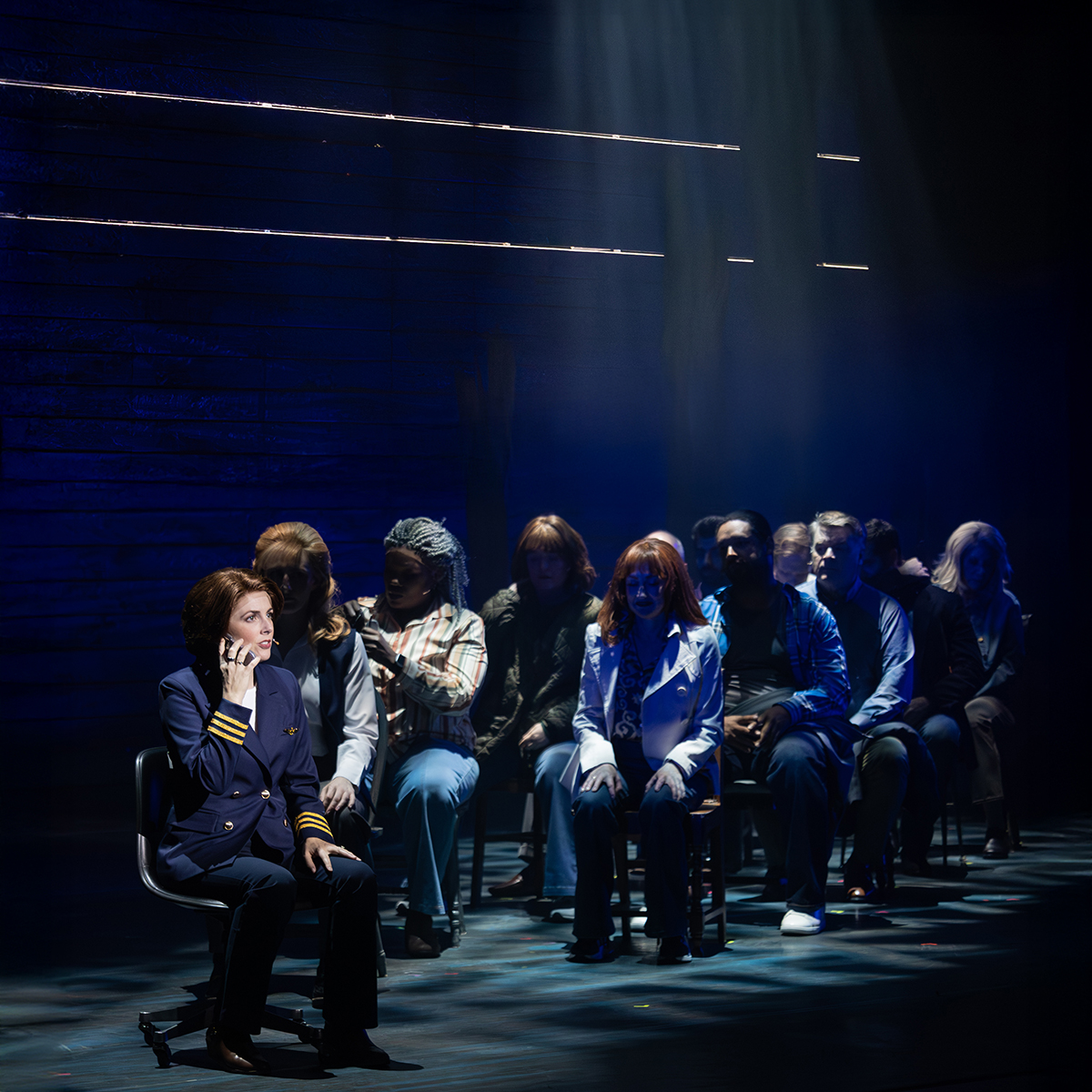
Bass, played by Fahrner, takes a call as the plane's passengers sit motionless behind her.
Photo by Casey Gardner Ford.
Fahrner’s motherly spirit shines through her character even after she has stepped out of the pilot’s shoes. The actress had a nerve-wracking flight to Pennsylvania scheduled the day after the show's final performance.
“I’m flying on Monday,” she said on the morning of March 29, “and I’m scared. I think part of the reason I’m scared is I don’t have my child with me to be strong for. When she’s flown with me, it’s like ‘No, I’m fine, I have to be fine. I have to.’ So I can relate to that within Beverley, very much.”
Beverley Bass was not the only “Come From Away” character Fahrner lived through; in her other role as Annette, the actress embodied an adventurous, hospitable personality, with a smidge of frivolity to lighten the mood.
“I love bouncing back and forth between the two of them,” Fahrner said. “These two very different humans, but also just two women. Beverley…if you look at pictures from back in the day, had beautiful long hair. When she had a blonde bob and was always in red lipstick, still very feminine. Annette just likes living out the excitement of ‘Ooh, there’s so many new people. This is so exciting, and I’m so happy.’ I think we all know what it’s like to live in a dream world of what-ifs. Her little vignettes with the different guys…I think we all can find that imagination within ourselves.
“I definitely connect more with these women than, say, Glinda. When I played Glinda, I don’t think I connected…I understand people that are a little bit on the outside versus people that are living in a really comfy space: Beverley being a woman who has gone for something that women haven’t, and then Annette, who, though she could probably settle down and have a marriage with a guy, she’s not. She’s living on the outside of that and just kind of giggling through life. I can relate to those humans a lot more than I can with the popular person on the inside.”
The principal messages of “Come From Away” are clear; Hein and Sankoff do not conceal its emphasis on the importance of human connection and aid in troubling times. The musical includes songs about accommodation (“Blankets and Bedding”), embracing your identity (“Costume Party”), comfort across ethnoreligious boundaries (“Prayer”), and universal inclusion (“Welcome to the Rock” and “Finale”).
These numbers, alongside the characters’ personalities, break down the concept of being a foreigner in a strange, new land over the course of the show. The passengers on Bass’ flight, initially differentiated as “come-from-aways,” undertake a unique induction ceremony to become honorary Newfoundlanders in the number “Screech In.” By the end of the show, Claude, the mayor of Gander, sings “Because we come from everywhere / We all come from away,” demonstrating how the “plane people” are just as deserving of care and respect as the residents of Gander.
A strong point of tension throughout the musical revolves around Ali, a Muslim passenger who faces temporary detention upon landing in Gander. The number “On the Edge” highlights some of this tension: While speaking to his mother over the phone in Arabic, Ali is confronted by two passengers who believe he is affiliated with the terrorist attacks in the USA. They bombard him with questions and verbal assaults such as “You celebrating this? You praying for your friends?” “You telling your Muslim friends where to bomb next?” and “Go back to where you came from!”
Later in the song, Ali visits Beulah, a friend of Annette’s who is managing the food for some of the passengers. Beulah quickly turns him away, as she had done on two of his previous visits, wary of his true intentions. This time, Ali reveals that he is a “master chef for an international hotel chain” who oversees restaurants across the globe; Beulah finally allows him to lend a hand.
A majority of the show’s characters, however, still distrust the Muslim passenger. As the passengers on Bass’ flight prepare to leave Gander on Sept. 14, the pilot notices airport security pulling Ali aside for private questioning, as he is a “perceived threat” to the safety of the flight.
The police strip search Ali. He explains an Arabic word, awrah, which refers to “the area between your stomach and your knees.” Exposure of awrah is haram—a forbidden practice in Islam. The police additionally require Bass to watch them; exposure to a woman is especially haram. Bass expresses her condolences once the search is over, but the officers have already violated Ali’s religious faith.
“Ali, who just because he looks a certain way, makes everyone pretty sure that he’s a part of what’s happening,” Fahrner said, commenting on the show’s portrayal of Islamophobia. “I hate that we immediately go ‘Oh, because that person is different, that now means they’re out to get us.’ Why can’t we just change? Why can’t we stop that?...Imagine how much nicer it would be if we could all be like, ‘Yay, you do you, and I’ll do me,’ and just ‘cause you’re doing you doesn’t mean that you want me to go away.”
For Fahrner, the strongest moments of “Come From Away” reflect not only the gift of compassion but also the beauty of recognizing and appreciating the world around you, turning minutiae—little moments—into minutes of mindfulness.
“We’re all living in a world, just waiting for the next thing to happen,” she said. “We all hurry up and get to the next thing, and we’re missing out on so much.
“The song ‘Stop the World’ is funny because I remember not thinking much of it before, and when I’ve listened to the album, it’s always like ‘Okay, let’s skip that one.’ Now…it’s really hard to sing every night because…we had deaths happen in our company. Someone had lost a parent, and he came and did the show, because he said ‘This is what my mom would have wanted me to do.’ My goodness, how lucky we are in this moment to be able to remind people about kindness and love and take a breath.
“Even as I was leaving [to] get home...for my daughter…as I was walking down the aisle, there’s that big green space…where all the fountains are, by the swinging seated benches outside of the theater. I just stopped.
"Stop it. Stop walking past this. Sit down, and take a minute.
“I sat in front of the fountains, just listening to the sounds of the water. It was nighttime, so all the lights were on the trees as I was taking it all in. Then all of a sudden, I noticed this one little tree that is covered in changing rainbow lights. Every other tree is either white or blue, and then this one little tree is living his life in rainbow arrangements.
“I’d never noticed that one. I think I was aware, as I’d walked past, that there’s lights of every color everywhere, but it wasn’t until that one moment that I stopped to take in my surroundings, to take a breath, to acknowledge what’s happening right now, that I was able to see the beauty of that one little tree.”
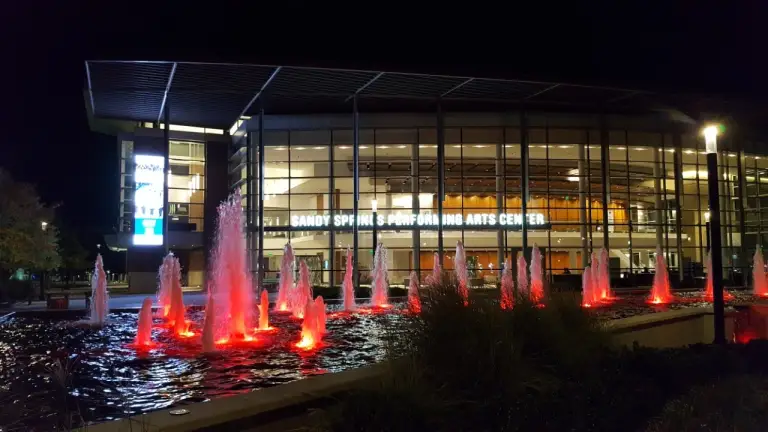
The fountains outside the Sandy Springs Performance Arts Center light up in a multicolor fashion, including a bright vermillion, at night.
Photo by John Ruch.
The busyness and blur of life prevail especially in the world of theater, where actors are often jumping between rehearsals and shows with minimal time in between commitments.
“I leave Monday to start ‘Dear Evan Hansen,’” Fahrner said, “and so it feels like we’re just constantly doing the next thing…Instead of thinking about ‘What’s next? How do we do this? Let’s get to the next thing, fight through the next thing,’ if we all just sat and took a breath, imagine what that could do.
“I’m really happy to be living in Georgia now. I have a daughter and a husband and a community that isn’t completely centered on theater where you’re constantly going ‘Well, what are you doing? What do you have going on next?’ No, we’re talking about life. ‘Hey, did you go the park?’ ‘Hey, did you see that art thing your kid put up?’ There’s so many other things that exist, even though there’s nothing else I would ever do as a job. I will hopefully be on the stage up until my last breaths.”
“There are cathedrals everywhere for those with the eyes to see” echoes the old, poetic sentiment. The world is and always has been beautiful; it is up to its inhabitants to find that beauty within themselves and within their surroundings. Every one of the “plane people,” just like every resident of Gander, faced a personal transformation over that long September week. “Come From Away” brings out the beauty within everyday people brought together by disaster, but united in their care and compassion for one another, for others who don’t speak their language or understand their culture, for strangers.
The characters within the show demonstrate passion and resilience just as much as their performers and real-life counterparts. Both Bass’ and Fahrner’s stories expose an industry dominated by physical stereotypes and diminishing norms. Both women stood in the face of these stereotypes and openly defied them, pushing their careers through limits and hardships unimaginable for many professionals in their same shoes today. “Come From Away” shows us that the power of the human heart and mind remains triumphant over all other forces in the world.
Fahrner leaves us with a message for the current generation of children, some of whom may one day grow into performers:
“For those in theater,” she said, “if you love it, and there’s nothing else you can do, make sure that it’s not your entire life. Not only is it important for your heart, but it’ll make you a better actor. The best way to learn is not by “Oh my god, how amazing am I? What brilliant thing am I doing?” but to look at the world around you, again, take a breath, connect with the world. Who knows—that person that you just watched swipe your groceries might be the next character that you pull from…The way that tree is moving outside my window might be something that feels like the way someone would move. The more you can…look around you and take in the beauty, and the darkness—all of it—the better actor you’ll be.
“Kids in general, take a breath and be a kid. Enjoy your life. I know [it can] feel like you have to know what’s happening for the rest of your life now, but you don’t. You can change your mind. You can change anything at any time, and you’ll be just fine. So follow your heart, follow your gut, and look around and connect.”
Q&A with Kate Fahrner:
Do you have any upcoming shows or local productions?
"I don't have anything local yet. I'm going to Pennsylvania to do 'Dear Evan Hansen,' and hopefully when I come back, there'll be some auditions. Fingers crossed."
Do you have any big connections on Broadway? Famous theater people you've met?
"I don't know if anyone will know them, but I did 'Millions' at the Alliance, which was the new Adam Guettel musical, and if people are Adam Guettel fans, they will freak out. I got to work with him and even the audition situation with him was unbelievable. I remember being like 'Pinch me right now. Adam Guettel was telling me that I'm revolutionary. This is insane.' And then to do a show with Steven Pasquale and Ruthie Ann Miles...We're all just humans doing the same thing, and I'm friends with them now. It was the same back in the day: Kerry Butler was my idol. I looked up to her like 'Oh my god, I want to be Kerry Butler one day.' Then I understudied her as well as the other women in the show and got to go on and play opposite her, and I was like 'This—this is crazy. I can't believe I'm doing this in life.'"
What does it feel like, having some people look up to you as a huge theater celebrity?
"It's so sweet. I remember when I was doing 'Wicked,' that feeling, because I just feel like another person coming out the stage door. I don't feel like anything special. I'm just Kate walking out the door, and these humans would be shaking. They put their arm around me, and they ask 'Can I take a picture?' and you think 'I'm just a person.' It's sweet."
In a professional theater environment, is it purely work, or is there a lot of fun time in between?
"Rehearsing is fun. There's a lot of laughter, a lot of fun. It's funny because three weeks is actually pretty long. There's a lot of theaters that give you seven to ten days to put something on. It's crazy. But even that, even in seven to ten days where you know that you have to get it done really fast, there's a ton of fun. There's always fun in that situation unless you have a really awful group of people...but I don't know that I've ever had a really bad group of people where I had a horrible time. There's always fun, even though it's work. It's the dream. It's what we love to do. So it's joy, pure joy."
How do you keep your voice in shape, especially for those really high notes in "Me and the Sky"?
"This track is weird. [Beverley] has the biggest range in the show, so most of what I sing is really low, and then randomly these couple of high notes. What's funny is the highest one I sing is probably the easiest of everything I sing...If I were younger, I would have been freaking out, and I would have been like 'No coffee and no pasta sauce and I must not speak.' That can't exist. I'm not a kid, so I'm not yelling. I'm not going to games. I teach voice lessons, and I have a lot of kids that'll show up one day and I ask 'Were you at a basketball game last night?' They say yes. I'm not doing that; I'm not screaming. But I do have a child, so I have to exist as a human. I do have voice lessons that I still have to teach, so I'm doing that all day. I just drink a ton of water and warm up before every show, which, gotta be honest, when I was younger—when I was Glinda—I never, never warmed up. So dumb. Now I warm up before every single show...I have to pitch my Beverley speaking voice in a lower place to give her more authority and to make her different from Annette. I think that's the thing that's hurting my voice the most...so when I get a chance to do this again, I'm gonna have to rethink that. But I really just drink a ton of water."
Were any of the costumes or wigs uncomfortable to wear?
"Nope. This show—this is a good one. Everything's comfy."
What's your favorite scene or musical number from the show?
"It's so hard. It's all one giant blur...There's weird moments that I like being a part of. I was just telling someone about this yesterday: One of my favorite moments, which isn't gonna make any sense, is when we're in the plane that's facing front after I've just talked to Tom [Beverley's husband] for the second time, and we sang 'Out of the windows / Into the darkness.' What's really cool is I feel like I'm in this weird surround-sound vacuum of people's voices coming and going. I start with [Steve Hudson, who played Nick] right next to me, and I hear him singing, and then I hear [Nasir Panjwani, who played Ali] walk by, and then I hear Kyle right behind me, singing, and he's got this amazing low voice, but then he drops out of the next line because he speaks. But then the next person I hear whom I haven't heard the whole time is [Shena Renne, who played Hannah]. So it goes from this low-whatever to Shena's fantastic voice. It feels like I'm in some twilight zone of 'What are these sounds?' because I see none of them. I just hear the sounds wafting. It's weird moments like that that I really love."
How difficult was it to nail down the Newfoundlander accent?
"So part of it is easy because I'm from Michigan, so there is a little a bit of that pseudo-Canadian, but it's an interesting cross between Canadian and Irish, and it's easy to accidentally go too far with one of those. When I was initially starting on my own, there were some parts of it that are similar to the slight Texan thing that I got going on [with Beverley], so sometimes I would mix them up. Luckily, I figured that out before we even got to rehearsals. Thank goodness, because I was like 'Oh, no, why do I keep doing that?' But now it just feels comfy, and I love it."
When you're preparing for a show—memorizing your lines or blocking or singing—do you have a go-to method for getting your stuff down?
"I wish I could say yes...My brain is all over the place. When I was younger, I had a photographic memory...and I'm dyslexic. So I would write out the entire script by hand, and I would memorize the entire thing. I wish I could do that now. Now I have a hard enough time with my own lines. Before I ever stepped into rehearsal, I would write out the entire thing, I would memorize it all (the photographic memory helped), mainly so that I knew why I was saying what I was saying. I wanted to know what that person was saying, what they were gonna have to say after I said it, so that I knew what to do. Now I'm in my 40s, I have a family and jobs, and I have to be an adult. I don't have the brain space to do it that way. This [show], because I knew it was going to be hard, I pulled both Annette and Beverley apart and made them their own worlds so that I could figure out what Beverley was saying in her order and in her voice and then figure out Annette's order and her voice. Nowadays, what I do to memorize stuff is I definitely connect it when I have physical stuff to do; that makes it easier to memorize. But I also write the first letter of every single word I have to say. I have a piece of paper with the first letter of every word so that I can look at it and go 'Oh, it's a v-word. I know what is is.' I saw someone doing that like a year ago and I thought 'I'm gonna try that, because the old way doesn't work anymore.' And praying to the gods doesn't always do it either."
Who's your favorite artist? What about your favorite musical or musical number? Favorite role you've played in any show?
"Right now, I'm really loving Couch and Olivia Dean. I don't fully know everything she sings, but every once in a while we're listening to something and I'm like 'Who's that?' and my daughter says 'Mom, it's Olivia Dean. You ask me that every time.' So I obviously most really like her. Musical-wise, honestly, my favorite musical and the most proud I've ever been of a musical that I've ever done is 'Fun Home.' I played the oldest Alison in that, twice. I was supposed to do it a third time, but I lost that to the pandemic. I think that story is so important: just the reality that we're all humans trying to make it through this life, trying to understand the stuff around us, whether we're gay, straight, whatever. We're all just people that have been brought up by other people trying to figure out what that is. My favorite part of acting is listening. I think it's the most important part of acting, to really, really listen. The best compliments I've ever gotten from people are when they're like 'I could have watched you listen for hours.' Thank you. What's fun about that role for me is how Alison gets to walk around and relive her life through these vignettes, just trying to understand and to really listen for a purpose, to try to find out who her father was, what her life was, how she got to where she is. I felt very lucky to be on that stage every night I've ever done that show, witnessing all the things happening, and just being able to see it and listen really hard. That's my favorite show of all time."
Are there any last words you have for Northview or for our students?
"What I want to say—and which is important for everyone to know—is to just reach out and ask. There's so many times that people are nervous about asking for what they want. And so we sit back—and I do this too, I sit back and think 'Oh, I don't want to bother' or 'Oh, I don't want to' whatever...To exist in this world, to exist if anyone wants to exist in theater, you have to ask for what you want. You have to go for what you want. And the worst that can happen is 'No' or no response at all. That's the worst that can happen. But see what can come out of it."