

Screens down
All the details of the bell-to-bell phone ban that takes effect next school year
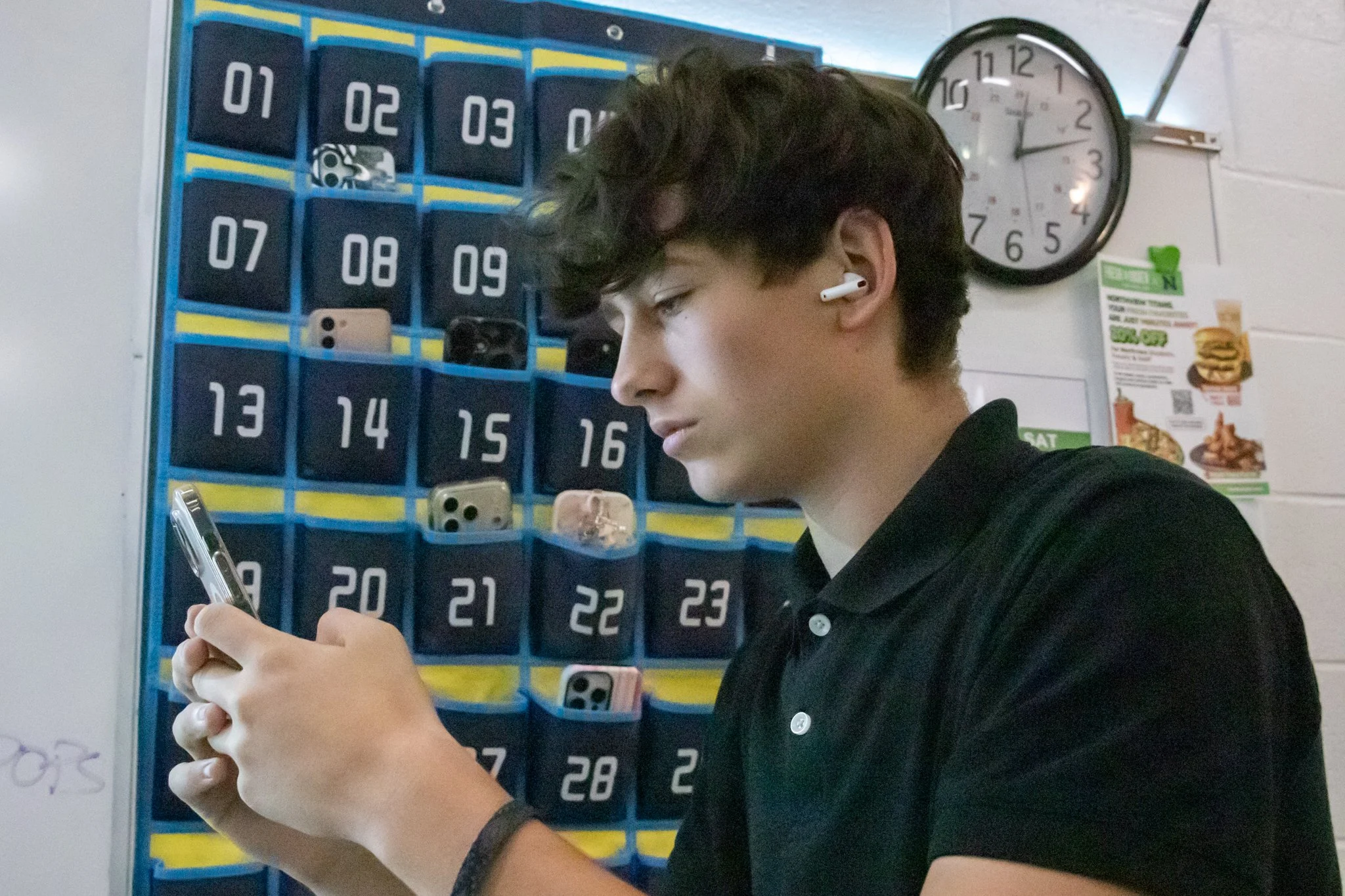
Photo by Ian Sands.
Vinaya Abraham, Staff Writer, Ian Sands, Editor-in-Chief, & Sophie Yang, Staff Writer
Colloquially known as the "phone ban bill," it aims to increase student productivity by instituting a bell-to-bell ban on cellular devices during the school day. The ban will take effect during the 2027-28 school year, but it has already garnered mixed feelings from teachers and students alike.
Scott Hilton, Georgia state representative for District 48, is the author and primary sponsor of the phone ban bill. HB 1009 seeks to solve a problem that has been growing for some time: phone usage during school.
"Over the last 10 years, we've seen a proliferation of personal electronic devices throughout school, and the data has shown it creates a distraction in the classroom and makes learning difficult," Hilton said.
Many school districts across the state have had personal device policies for some time now. The issue was that these policies varied in many aspects, like the punishment policy, duration of the ban, and methods of storing the devices. One of the goals of HB 1009 is to centralize the parameters of the ban so there aren't any discrepancies between districts. The bill mandates a "bell-to-bell" ban of phones, meaning that students cannot use their devices in between classes, at lunch, or any time during the official school day. While it requires these parameters, districts have the discretion to choose how the devices are stored.
"That's the beauty of the bill--every school can design a program that works best for them," Hilton said.
While HB 1009 doesn't explicitly require them, "locked pouches" are one of the potential methods listed for phone storage, with many schools around the country having already implemented them. These pouches, like most other storage methods, are not free. Yondr, one of the most prevalent phone pouch companies, charges $25-$30 per student. The bill addresses this problem by enabling schools to access grant money to pay for the storage solutions.
"At a state level, we have allocated school safety resources through grants to the school systems... it is based on student population, but every school [has] about a $100,000 block grant every year related to school safety," Hilton said.
One of the main concerns with this bill is that in a hypothetical emergency situation, students would be unable to access their phones to contact parents or emergency services. HB 1009 creates some measures to guarantee safety in such an emergency.
"In the language of the bill, it says schools need to develop a policy around emergency situations to reunite the child with the phone... We talked to a number of safety experts who all universally said that in an active shooter situation children are safer without cell phones, they listen to instructions, get to a safe spot real quick, and then get reunited with [their] phone," Hilton said.
Many districts, including Fulton, have already begun revising their personal device policies in preparation for the law to take effect next year. Marisa Disano, Assistant Principal at Northview High School, commented on the school's specific policy regarding phones for the 26-27 school year.
"Right now, we are following Fulton county's policy of no phones during instructional time. When the phone ban comes down from the state, we will follow what the state tells us we need to do," Disano said.
The phone ban doesn't just affect students. Teachers have also reported that they find the ban helpful. Dr. Ashley Ulrich, an ELA teacher at Northview who has been teaching for 19 years believes that the ban has more authority than classroom rules.
Currently, teachers create rules based on their own discretion. For example, some teachers allow students to keep their personal devices stowed away during instructional time, while some teachers require students to put phones in a chart or specific area. Thus, teachers have different approaches in their classrooms.
"The ban is enforceable by federal law, not just... a teacher," Ulrich said. The new phone ban mandates that schools adopt the ban, so teachers aren't the ones deciding whether phones are used or not.
Distraction is a problem in classrooms, and it's challenging for teachers to deal with personal devices. Ulrich has experienced teaching before and after schools started providing personal devices for every student, and she observed that students' behavior has changed due to the laptops.
“You just can't be giving your full attention to something if your attention is split with something else," Ulrich said. "The ban will eliminate distractions and allow teachers to focus on teaching rather than making sure every single student is being productive and focused on their assignment instead of their phone."
Student responses vary as the first effects of the bill are starting to settle in. Some wonder if the bill was truly created with the intention to help students. Northview student Cadence Winkler believes that this ban was not placed with the intention of supporting students, but rather to boost the image of Georgia's educational department.
“I feel like the only reason they passed the phone ban is because it looks good on paper,” Winkler said.
Many students are concerned that in the event of an emergency, not having access to their cellphones would put them at an even greater risk. Having other safety precautions rather than banning cellphones is something that has been brought up by numerous students. After parents spoke out and explained their apprehensions, the state of Georgia revealed that in the event of an emergency, plans and a variety of different strategies were created to keep students safe.
A major reason that the state implemented this bill in the first place was to increase student engagement in the classroom and reduce mental stress. One main goal of HB 1009 is to take away distraction in the classroom and create a clearer learning environment. Winkler, though, feels that there are different motives.
"Education has become more of a business...It's not really about actually caring to improve our test scores," she said.
Earlier this year, Gov. Brian Kemp signed House Bill (HB) 1009 into law. It has quickly become one of the most discussed topics around Georgia schools. While the bill is quite contentious, it is clear that schools are going to need to adapt quickly to these new changes. Despite complaints from students, Hilton believes the bill will ultimately help them, and five years down the line he hopes to see positive change.
"I'd like to see what we've seen in other states, which is test scores go up and students' emotional and social well-being improved," Hilton said.