
The growing push to lower the voting age
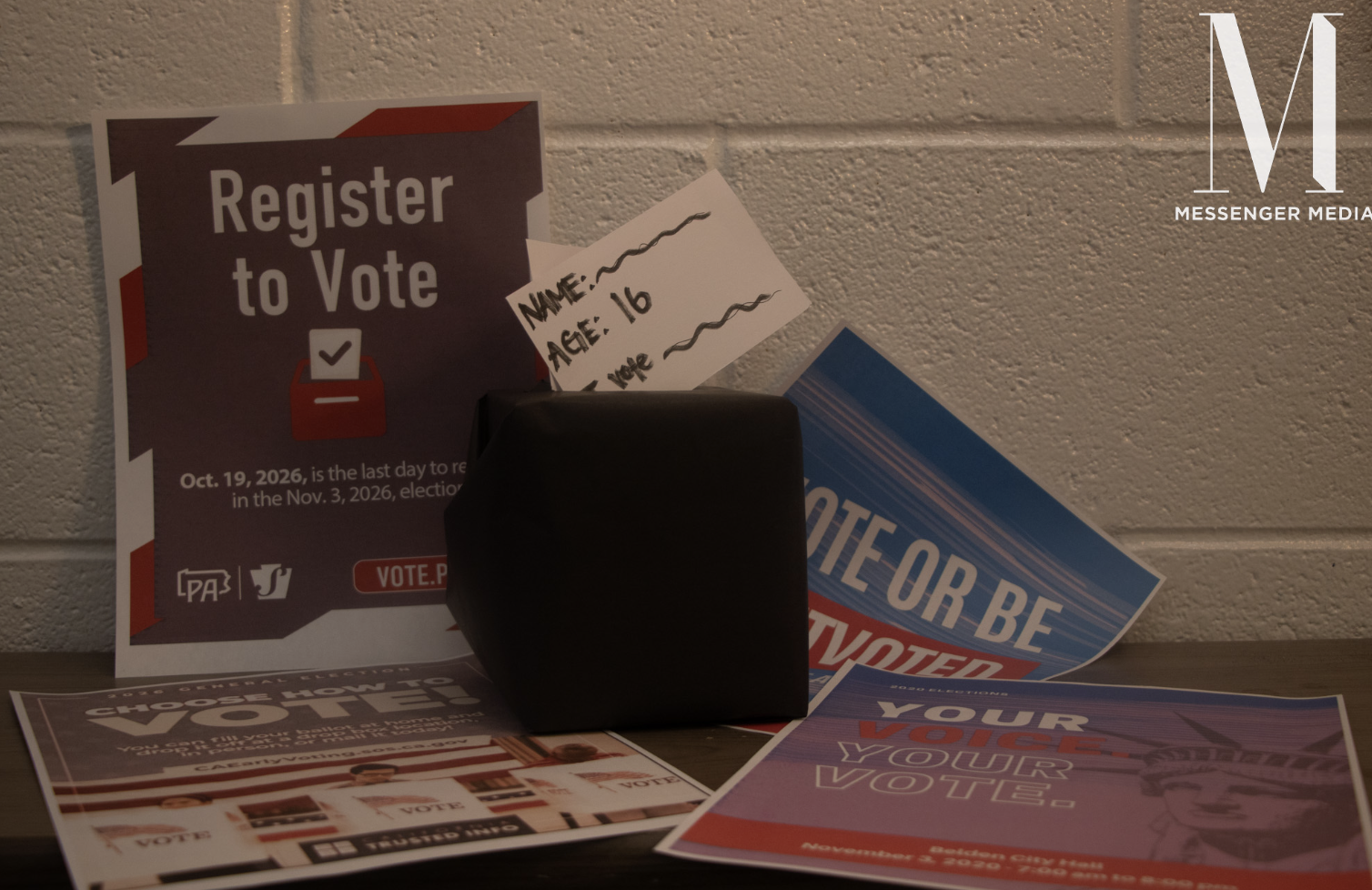
Photo by Miya Anderson.
Sheehan Banka, Features/Website Editor, Miya Anderson, Staff Writer, & Yalee Orlinsky, Staff Writer
2024 was the largest election year in history. Over half the Earth's population was able to vote in local, regional, or national elections. Among the enfranchised were an estimated 10 to 15 million voters under the age of 18.
Nearly a dozen countries, including Austria, Brazil, Scotland, and certain states of Germany, enable 16- and 17-year-olds to participate in all government elections. Many other European countries permit under-18 voting in European Union (EU) elections. Within the United States, thousands of non-adult high schoolers can vote in local elections in cities such as Oakland, California, and Newark, New Jersey.
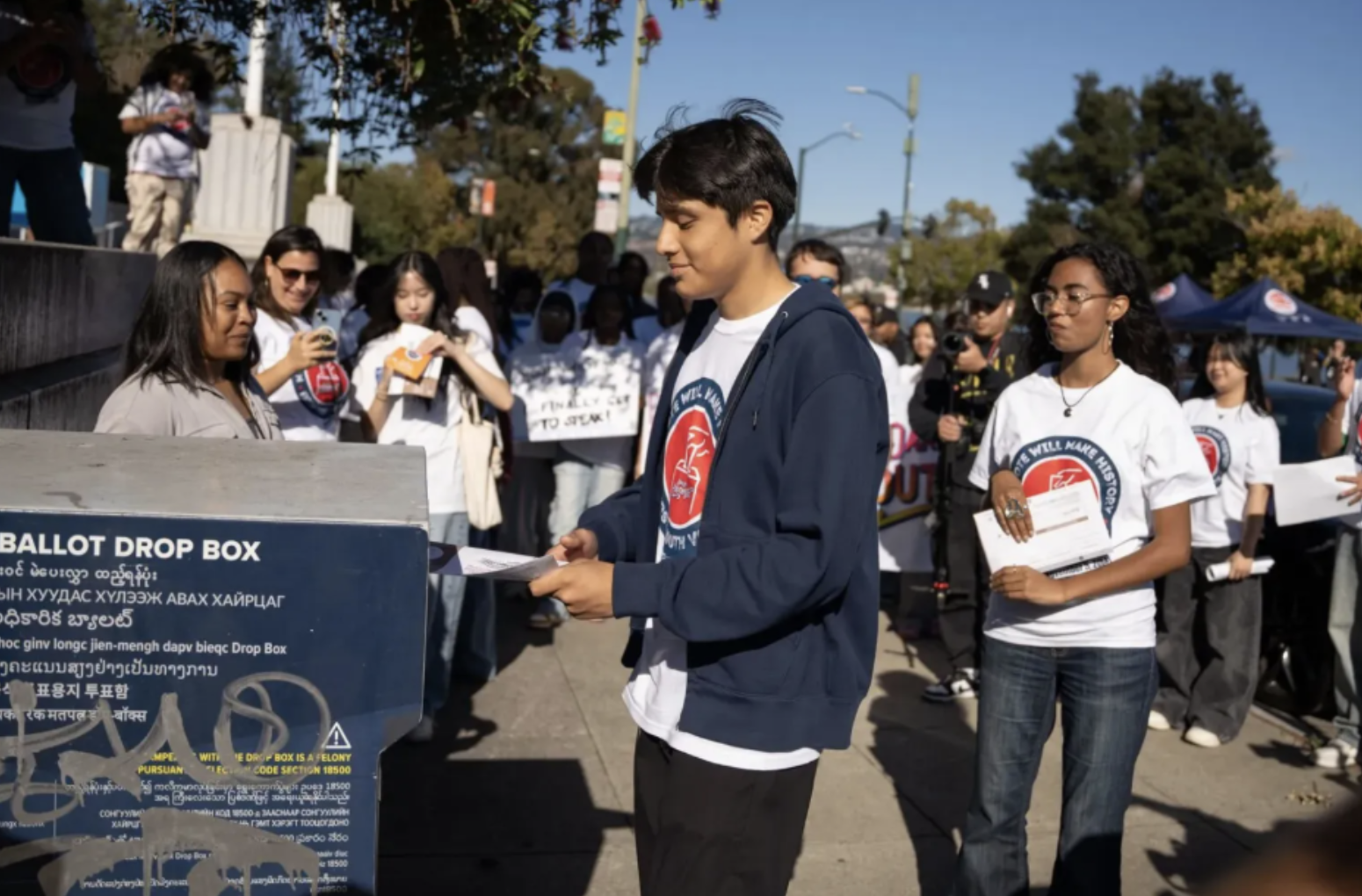
Photo by Florence Middleton.
The movement to lower the voting age to 16 (commonly known as Vote16) has surged in recent years, though despite its expansion to a number of cities, voting at 16 is still far from a national standard. The U.S. has not lowered its voting age at a federal level since the passage of the 26th Amendment to the U.S. Constitution in 1971, which prohibited all states from setting their voting age above 18.
"Either two-thirds of Congress or states have to propose [an amendment], and then three-fourths of state conventions or legislatures ratify it," Stephanie Roche, an AP United States Government & Politics Teacher at Northview High School, said. "The amendment process takes a long time. Logistically...at local levels, it would probably be easier to change some of the laws."
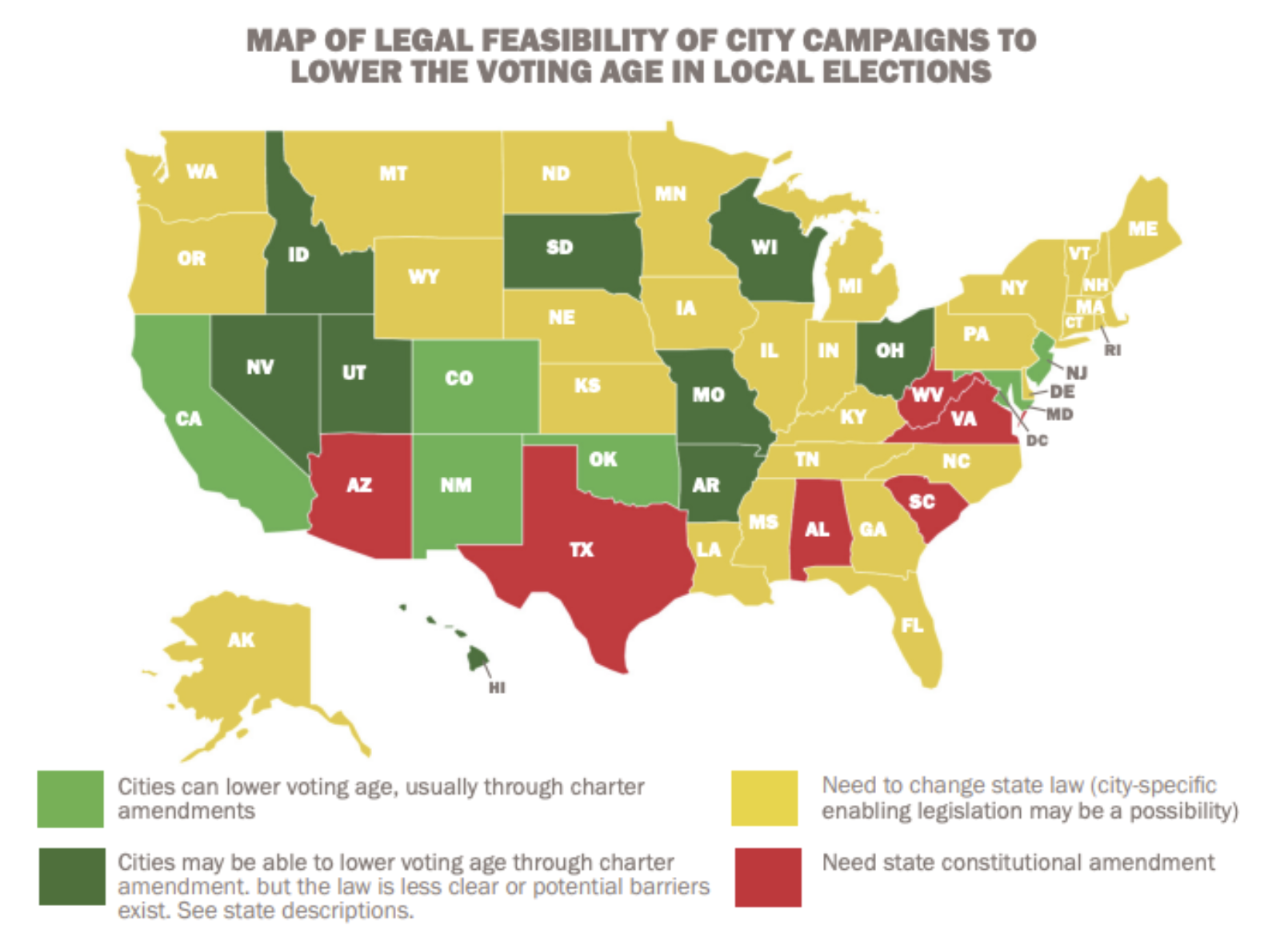
Congress passed the latest Constitutional Amendment in 1971, over 200 years after its initial proposal. The uncertain timeline of amending the Constitution has pushed many organizations advocating for a lower voting age to target state or local laws first.
Vote16USA is a nonpartisan nonprofit that establishes campaigns in individual states with the ultimate goal of federally lowering the voting age to 16.
"Extending voting rights to 16- and 17-year-olds is the next big thing in American democracy," LaJuan Allen, the Executive Director of Vote16USA, said.
As a political science and sociology major, Allen emphasizes the importance of local participation as a catalyst for the Vote16 movement to garner sufficient congressional support.
"When we're talking about federal amendments, it's really important to have data," Allen said. "The data you get from these smaller cities and states is what you're going to use to lobby for federal legislation."
Graphic by Sam Novey.
Advocacy groups such as FairVote and the National Youth Rights Association (NYRA) share Vote16USA's mission. Some view the age barrier to voting as a form of discrimination against children who work, drive, or may otherwise be financially independent.
The most widespread argument for a lower voting age comes from a mass of scientific studies on adolescent brain development, specifically in the fields of cold cognition. Cold cognition involves processing information through an objective, rational lens (as opposed to hot cognition: reasoning more subjectively or emotionally). Decisions that require critical thinking skills, such as researching policies to vote for a candidate, are associated with cold cognition.
The Association for Psychological Science claims the brain structures that control planning and logical reasoning fully develop in most people by the age of fifteen. The National Institutes of Health corroborate that a majority of adolescents reach the same level of cognitive capacity (cold cognition) as the adults in their environment by the age of 16, while their psychosocial maturity (hot cognition) tends to follow a longer trajectory.
"For someone who's 16 years old versus someone who's 55 years old, the level of cold cognition is pretty much the same," Allen said.
Allen also cites increasing turnout and political efficacy among newly-enfranchised youth voters as evidence for the success of the Vote16 movement.
"In the places in America where we've seen 16- and 17-year-olds be able to vote," he said, "the turnout rate for 16 and 17 in every single case is higher than that of those who are 18 and older."
In May 2013, after a decade of campaigning by the NYRA, Takoma Park, Maryland, became the first U.S. city to lower its voting age to 16. Later that year, fewer than 1,000 of the city's 17,000 residents voted in its municipal elections. Within that block, however, were 59 of the city's 134 registered voters under the age of 18: a youth turnout of nearly 50%.
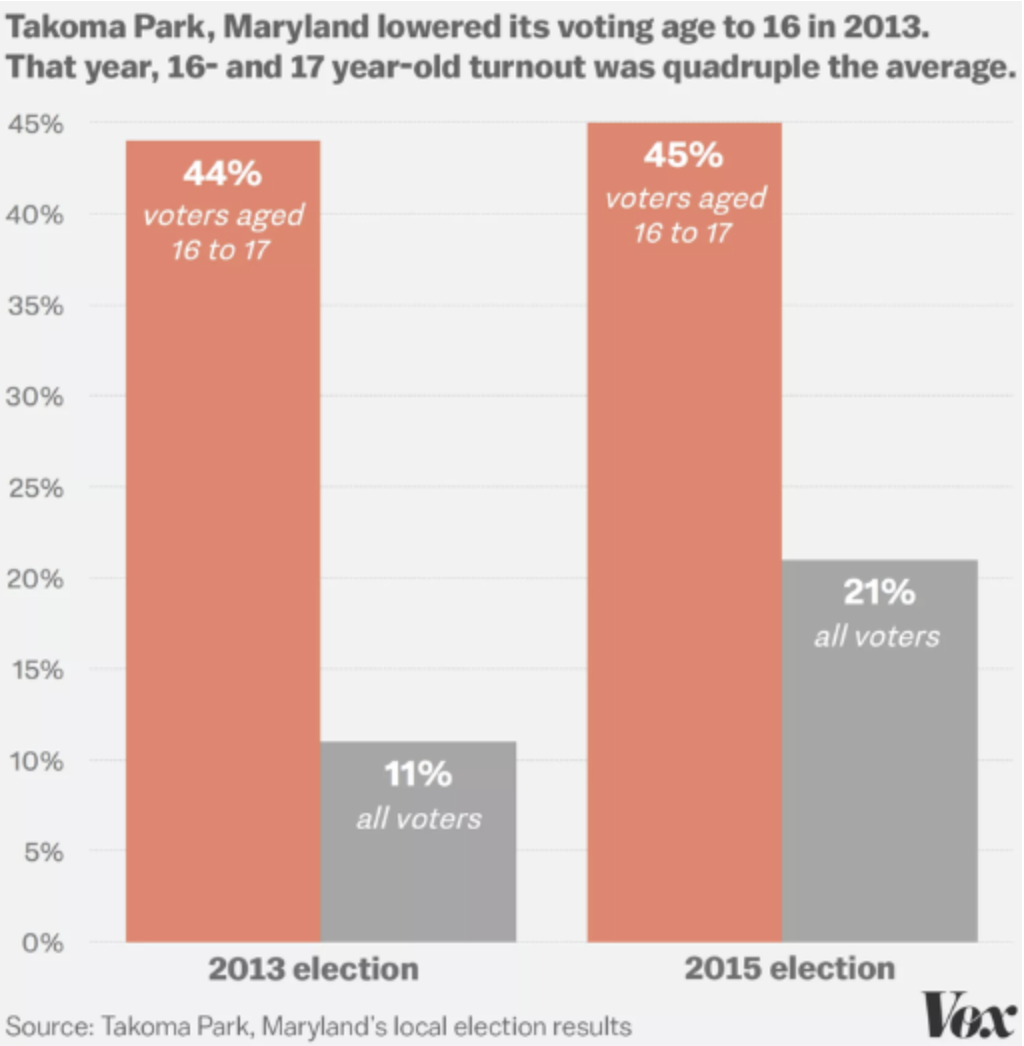
Graphic by Vox.
High turnout is one of the strongest indicators of a healthy democracy, and the overall trend of growing turnout with time provides further empirical success for the movement.
"When Takoma Park...allowed 16- and 17-year-olds to vote, we also saw a dramatic increase in the average percentage of voter turnout," Allen said. "What that tells us is that 16- and 17-year-olds are encouraging the people in their lives that are 18 and older—aunties, uncles, parents, cousins—to get out and vote."
The right to youth enfranchisement may also be a matter of humanitarian law at an international scale. Article 12 of the Convention on the Rights of the Child (CRC) by the United Nations Children's Fund (UNICEF) ensures signatory governments will provide children "capable of forming [their] own views the right to express [their] views freely in all matters affecting [them]." The degree to which member states consider those views must be "in accordance with the age and maturity of the child."
The debate on the applicability of the CRC to the electoral franchise stems from discrepancies around how to determine at what point a child is capable of forming their own views. Think tanks such as the Heritage Foundation oppose U.S. ratification of the CRC, claiming the agreement threatens to undermine family sovereignty. A 2025 article by the Cato Institute examines the expansion of parental rights in the aftermath of the COVID-19 pandemic—the same years as recent surges in the Vote16 movement.
Organizations opposed to the cause commonly cite a lack of emotional maturity, political efficacy, independent thinking, and real-world experience among adolescents as rationale against lowering the voting age. Teenagers themselves often feel they have insufficient critical thinking skills to evaluate the political material accessible to them. Per a 2021 UNICEF study, more than two-thirds of children under the age of 18 reported an inability to judge the accuracy of digital information in countries such as South Africa and the Philippines, where that age group comprises about a third of the total national population.
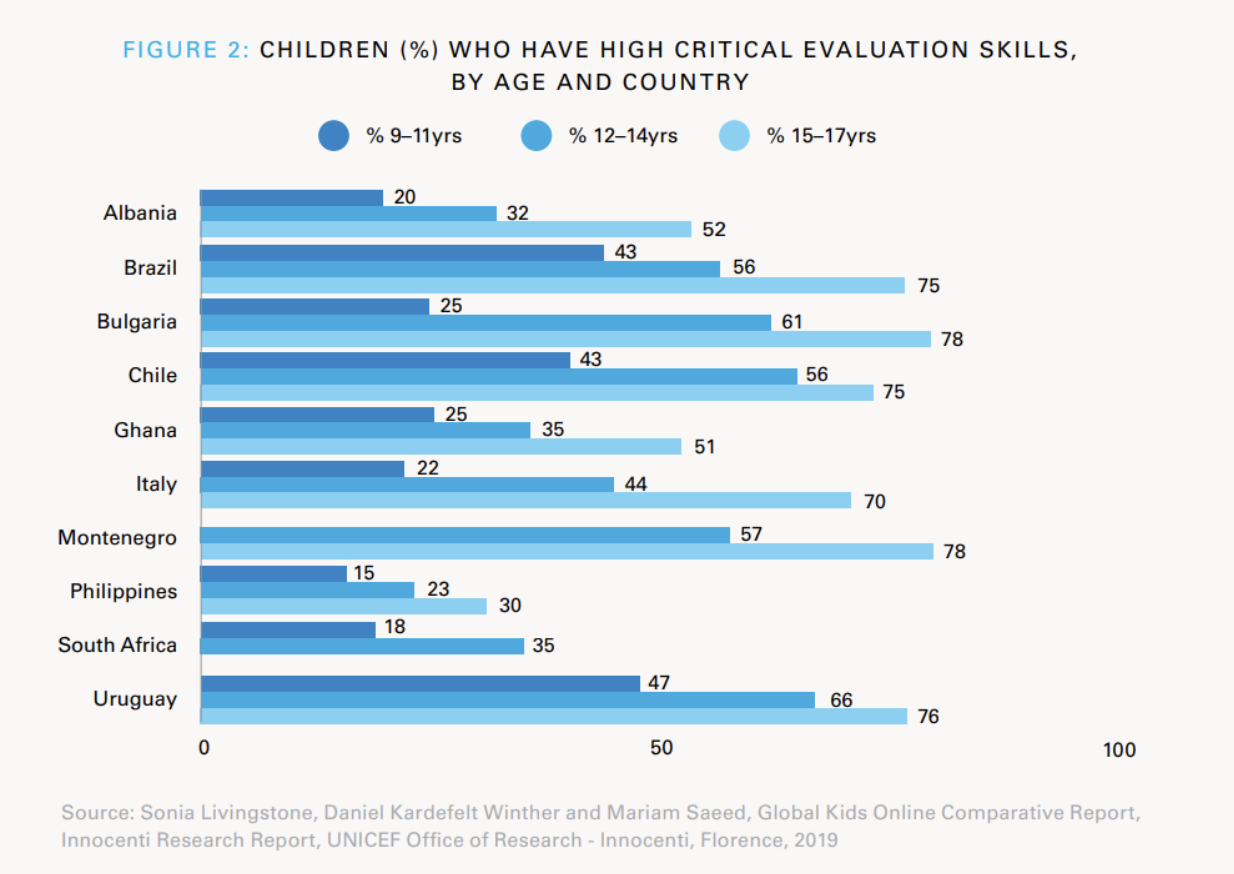
Graphic by UNICEF.
Political knowledge and civic engagement have fallen among schoolchildren in recent decades. Less than a quarter of all eighth graders in the U.S. demonstrated proficiency in civics and U.S. history on the last National Assessment of Educational Progress (NAEP) in 2022, marking a gradual decline since the first iteration of the test in 1998. Generation Z also demonstrates a reversal of the Flynn Effect as the first generation in modern history to average lower on IQ tests than its predecessor.
Some advocates of Vote16 believe a lower voting age could combat this decline in political awareness.
"If anything, lowering the voting age would make the younger generation more interested in politics since there's something they can do about it," Matthew Chung, a senior at Northview, said.
Others see a lack of efficacy as a preference rather than a disincentive.
"A lot of us have our beliefs, our identities figured out enough to where we can decide if we need to vote," Northview junior Emily Arnette said, "and if we don't feel ready to vote, that's our choice. It's part of being in America."
The Vote16 movement has possibly become a partisan issue as well. When Massachusetts Representative Ayanna Pressley attempted to amend the For the People Act to extend voting rights to 16- and 17-year-olds in 2019, 125 Democrats and 1 Republican voted in favor of the bill. To prevent such statistics from dispelling potential members, Vote16USA and other advocacy groups emphasize the separation between their goals and any partisan affiliation.
"No matter where you fall on the political spectrum, this is something that is important to people," Allen said. "Whether you're a Democrat, or a Republican, or an independent, Green Party, Libertarian, etc., those things don't matter to us at all."
Party-affiliated or not, most Americans are currently against the idea of a lower voting age. While 126 congresspeople supported Pressley's proposal, 305 others voted against it. A 2025 YouGov poll revealed more than two-thirds of U.S. citizens—Democrat, Republican, or nonpartisan—believe the minimum federal voting age should be 18 or higher.
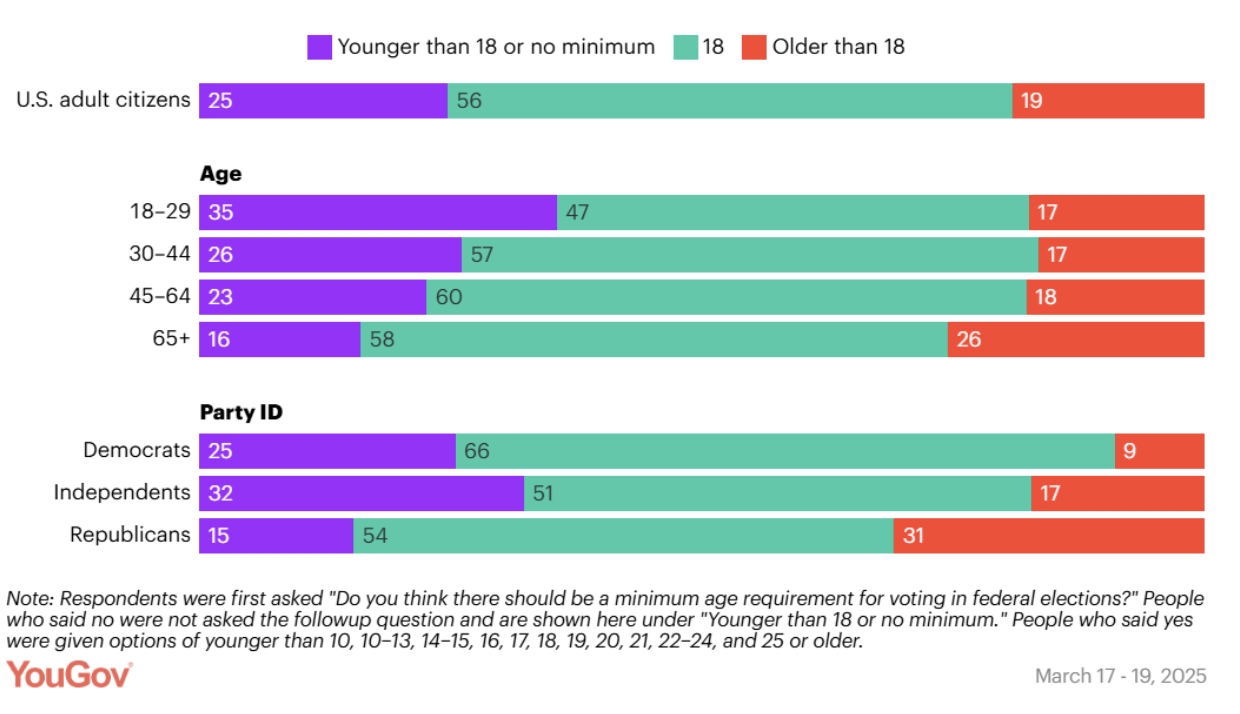
Graphic by YouGov.
The push for the 26th Amendment in the 1970s relied on a nearly uniform social movement through the country. Support proliferated on both sides of the political spectrum, and the amendment became one of the most bipartisan pieces of legislation enacted in U.S. history.
"Before the Twenty-Sixth Amendment, people were being called into the military to die and fight for their country yet couldn't even vote for the commander-in-chief," Roche said.
Vote16 campaigns today are relatively less unified across cities and states. Supporters typically cite a number of factors, rather than one overarching reason, to justify the movement.
Proponents of Vote16 believe popular aversion to an up-and-coming ideology is always vulnerable to change, especially in a field as volatile as the electoral franchise.
"Every suffrage movement, when it started, was not very popular," Allen said, "and it took a lot of time to embed those ideas into the fabric of American culture...I don't think this is the panacea to all the problems, but I certainly think it is a part of a broader strategy around some of the solutions."
Within the Western world, the United States has been one of the later countries to implement some Vote16 policies. Austria, Belgium, Germany, Greece, and other nations allow their citizens to vote in certain EU elections from the age of 16 or 17. Perhaps the movement's greatest recent European advancement is the United Kingdom's Representation of the People Bill. The legislation, introduced in Feb. 2026 and currently awaiting scrutiny in the House of Lords, seeks to permanently reduce the voting age for all UK elections from 18 to 16, enfranchising nearly two million teenagers.
Lobbying for new legislation is a lengthy process, and in many U.S. cities, a positive feedback loop further hinders the establishment of a lower voting age.
"It is that vicious cycle," Roche said. "Some cities are not going to implement the lower voting age because younger voters have lower political efficacy. And if the government doesn't focus on young voters...then they're not going to turn out."
The progression of the Vote16 movement has never been effortless, immediate, or immaculate. Though with the recent rise in awareness and campaigns both across the country and around the world, it is unlikely that its supporting programs will fizzle out soon. As organizations like Vote16USA continue to advocate for a lower voting age, more and more adolescents join the cause, and legislators on either side increasingly express their views. Enough baby steps may lead to a platform for the children, or the impenetrable law may retain its current standing. Unstoppable force meets immovable object: Who will win? Only time will tell.