

The rise of college football popularity compared to the NFL
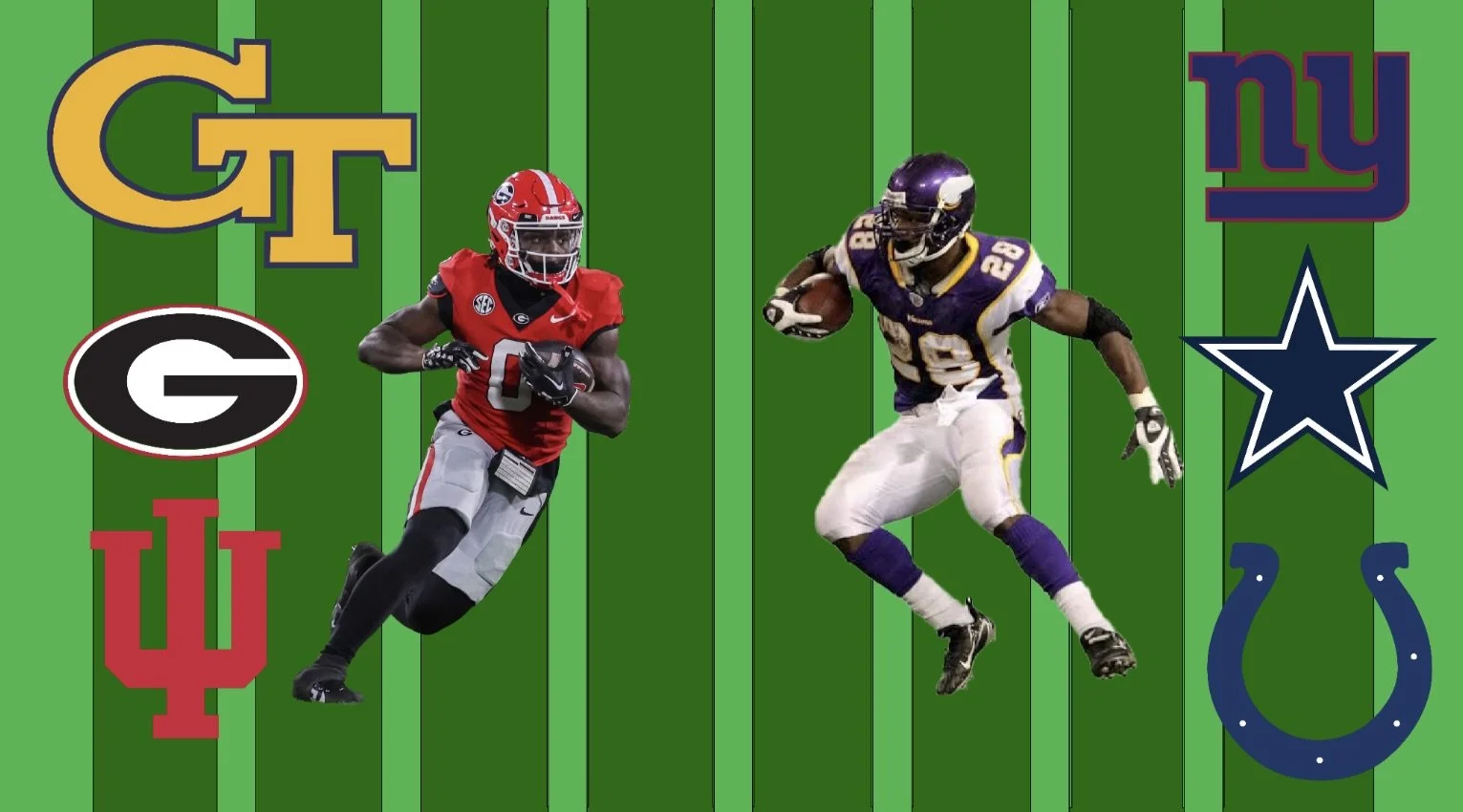
Design by Dylan Gooch and Ian Sands.
Ian Sands, Editor-in-Chief, Dylan Gooch, Staff Writer
People look forward to the fall season every year for three reasons: dropping temperatures, changing leaves, and the yearly return of football. It's no secret that the sport is an undeniable staple of the season. In November, families celebrate Thanksgiving Day by watching the Dallas Cowboys. Since its inception in the early 1900s, the National Football League (NFL) has been the irrefutable king of football, but in recent years, the crown of football has been slipping. A host of changes to the sport has led college football to gain massive popularity.
College football has been around even longer than the NFL, with the first game being played between the Rutgers Scarlet Knights and Princeton Tigers in 1869. Since then, the sport has gone through a metamorphosis. In 2014, the National Collegiate Athletic Association (NCAA) created the College Football Playoff (CFP), in an effort to make the crowning of a champion each year a fairer process. The inaugural National Championship game between the Ohio State Buckeyes and the Oregon Ducks drew nearly 34 million viewers, but year after year, that number steadily declined until 2023, when it reached its lowest point. The game between the Georgia Bulldogs and Texas Christian University (TCU) Horned Frogs was a blowout, with Georgia winning 65-7, as only 17 million viewers tuned in. The NCAA rectified this downward trend by once again changing the rules of the CFP; instead of four teams, in 2024 they announced a switch to a 12 team playoff, a segue that has seen great success. Last year's matchup between the Indiana Hoosiers and the Miami Hurricanes saw 30 million viewers, the second most watched championship game in playoff history. Viewership has quickly flipped, from a downward turn to an upward one.
The CFP is not the only change to college football in recent years; NIL (Name, Image, and Likeness) has also transformed the game. NIL is essentially a college player's legal right to earn money from brand deals, sponsorships, or endorsements. In practice, it allows teams to pay their players through booster organizations and revenue sharing. This change has led to a tangible increase in parity across the sport. Before NIL, the average margin of victory for the Southeastern Conference (SEC) games (widely considered to be the most competitive conference at the time) was 16.7 points; that number has dropped to 10 points. This indicates a drastic increase in the level of competition for power conference teams. With superstar players spread amongst the entire field, the competitiveness of many teams has gone way up. In the past four years, the NCAA has crowned four unique national champions; it's apparent that the dynasties of the old days have come to an end.
One of the prime examples of this is the University of Indiana. For years upon years, Indiana has been known as the laughing stock of college football harboring one of the worst records of all time. But recently, coach Curt Cignetti has turned the program into what is now recognized as one of the best teams in the league. This is a result of the NIL portal giving a large variety of teams a chance to attract superstars of the sport. Brian Tavani, sophomore at Northview, commented about the effects on NIL
"A lot of players are transferring every season and making as much money as the pros," Tavani said.
This incentive of money is permitting top-level recruits to be spread around the portal, and not gravitating towards the same two powerhouses. Which in turn, evens the playing field.
The NFL has been quite contradictory, as in recent memory there seems to be a pattern in the champions of the Super Bowl, rotating between the same familiar teams competing for and winning the trophy. This familiarity is a big reason for the decline in viewership over recent years; it gets boring if there are the same few teams on the big screen. In the past 10 Super Bowls, the Kansas City Chiefs have won three times, and the New England Patriots and Philadelphia Eagles have both won twice. While ratings have generally seen an increase over the past few years, the beginning of the 2026 season has seen a slight dip. Despite this, Northview Students have a wide range of opinions about which they prefer.
"In the NFL, there are more powerhouse teams that are constantly in the playoffs," Sophomore Carter Sutherland said. "In college football, a lot of different teams win year by year, and changes are made more often, making it more interesting."
It's no secret that football is an incredibly divisive subject. People stick by their teams with unrivaled loyalty, but it's also clear that the fans have preferences on which league they watch. Although the NFL remains an indifatigable goliath, college football has begun to grow more and more. The increased parity, larger number of games, and student culture have led to college football expanding rapidly.