

Practice what you preach
The paradox of modern environmentalism
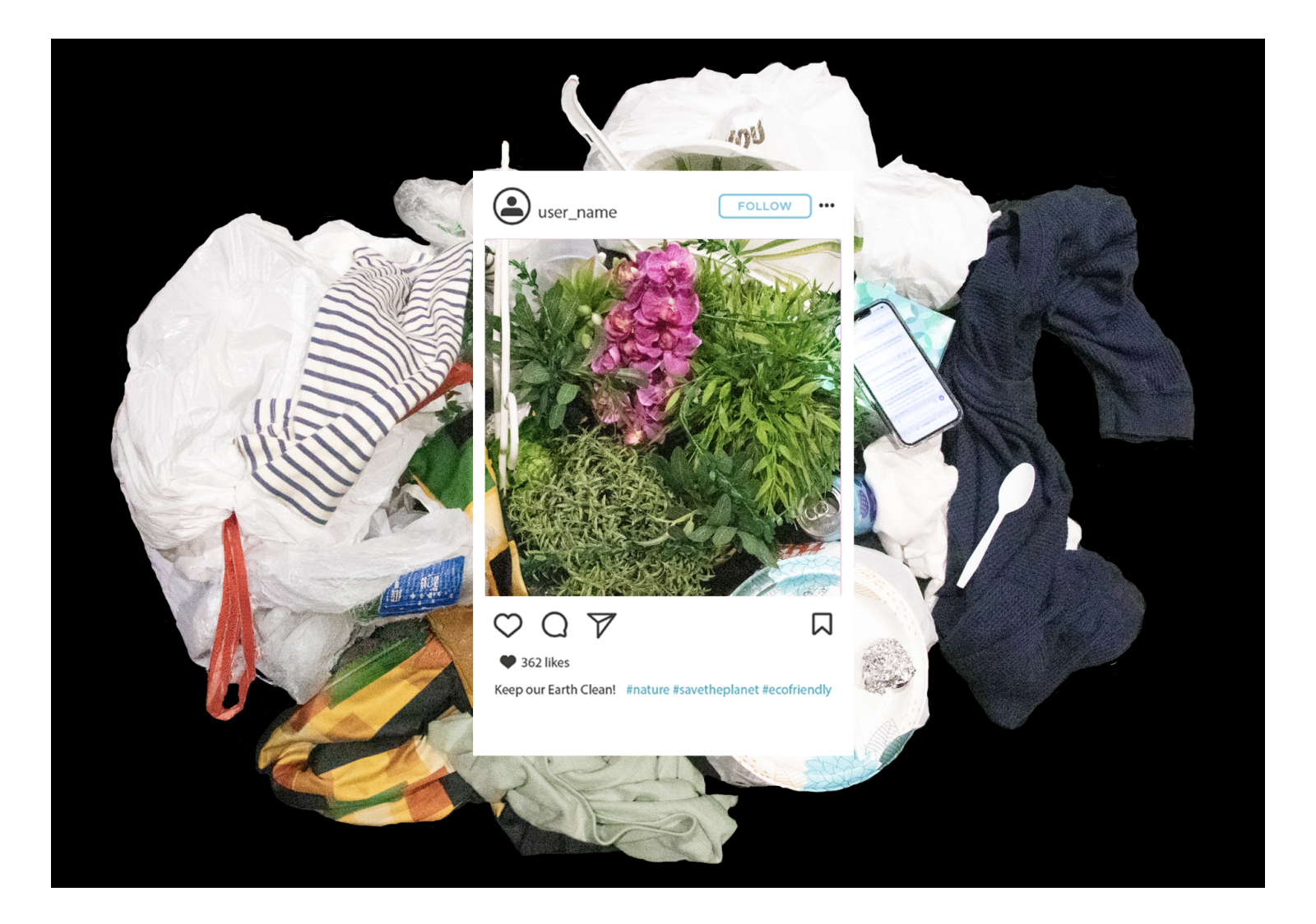
Photo by Zulfah Muzammil and Olivia Sung.
Zulfah Muzammil, Staff Writer & Olivia Sung, Staff Writer
There are millions of Instagram posts and hashtags preaching to protect the Earth, care about the environment, and keep our planet clean. But how many of these people actually stepped out of the digital realm and impacted the real world? How many of their actions spoke louder than their words? We scroll through catastrophic headlines about melting ice caps and profess a deep, existential love for our planet. Yet if we take a long step back and evaluate our daily routines, we realize something. Our lifestyles are actively fueling the crisis we claim to mourn.
Humans always want more. There are never enough shirts, pants, or shoes to satisfy us. There is always a need to produce more clothes despite the landfills looking fuller than ever. The concept of fast fashion is cheap, low-quality clothes built to meet new short-lived trends. Some popular brands include Zara, Shein, and Temu. Fast fashion takes up 10% of all carbon emissions in the world, with 85% of all textiles going into the dumps, polluting our rivers and lakes. Even the act of washing these clothes releases 500,000 tons of microfiber into the ocean each year—the equivalent of 50 billion plastic bottles. Most people claim they're against these brands because of the catastrophic effects they have on the environment. But do people really stay true to their beliefs? As soon as a huge sale kicks off, a cute 2000s-themed collection drops, or their favorite influencer has a trendy outfit, people choose to neglect their previous grudges about these companies.
Psychologists call this "cognitive dissonance," the mental discomfort of holding conflicting beliefs and behaviors. To soothe our guilt, we indulge in performative environmentalism. Although the people buying these products are not the ones physically dumping the clothes into landfills, they are the people who reinforce the idea that buying fast fashion is okay when it's for their own benefit.
What about the student who has an essay due in 20 minutes? They might say, "Just this once," as they pull ChatGPT up in a new tab. But the next time they procrastinate another assignment, they'll repeat the exact same phrase and action once again. AI drains hundreds of gigawatts of electricity. To combat this, companies have turned to water-based power. This places immense pressure on the world's water supply, stripping rural areas of water, which causes drought-like circumstances.
Students know the consequences of using AI, but the moment they need it for their personal convenience, their previous judgments on AI vanish. Suddenly, people try to cover up their guilt and hypocrisy by making their AI usage seem like a one-time thing or an action that has a minuscule impact on our world, while knowing deep down that they're going directly against their core beliefs. UN University has even brought up a study that reports how AI-related water consumption could equal the basic needs of around 1.3 billion people by the end of the decade. Is using AI for your assignments truly more important than the well-being of 1.3 billion people?
This hypocrisy even extends to our dinner plates. Many of us claim to love animals and despise the industries that cause harm to our environment. Yet, how quickly do these ethics vanish when we set foot in a fast-food restaurant? It's hard to ignore that mass-producing meat leads to mass deforestation, depletes water supplies, and fills our atmosphere with greenhouse gases. A single quarter-pound hamburger patty takes 660 gallons of water. This accounts for everything from the crops grown to feed the animal to the processing of the meat. That's enough water for approximately 38 eight-minute showers, 15 full bathtubs, and 30 loads of laundry. We all know the cost. But the moment we smell a burger or want to buy a cheap and quick meal, our appetite overrides our conscience. We disconnect the meat on our plate from the destruction it causes because facing that reality is scary and inconvenient. It's much easier to enjoy your meal rather than think about the environmental costs. But it shouldn't have to be this way.
It might be easy to shrug and say, "I'm just one person; what difference will I make?" But what if everyone says that? Just imagine the sheer number of people who repeat this phrase in their head. Actions add up, contributing to a much bigger impact on the environment than people think. It isn't just about your impact on the environment. At the end of the day, it's about aligning your actions with your beliefs. It may seem like a burden to give up the daily conveniences of your life to contribute to slow, systemic change. But everyone acknowledging their individual faults and changing their daily habits will lead to change, even if it's slow. Slow progress is far better than living in hypocrisy and making no change at all.
So the next time you post your story, think of its impact and what it serves beyond the digital world. Think of what you can do to support your story's message. The solution is not to give up modern convenience but rather to be more mindful of the choices being made. By practicing this, we can move beyond performative activism. Recognize if what you're preaching matches up with your daily choices. If you stop being an environmentalist the minute it becomes hard, it means you never truly were.