

Act your age… not really
From childhood to the workplace, women face conflicting and contradictory expectations
Design by Hannah Kwon.
Hannah Kwon, Staff Writer & Yalee Orlinsky, Staff Writer
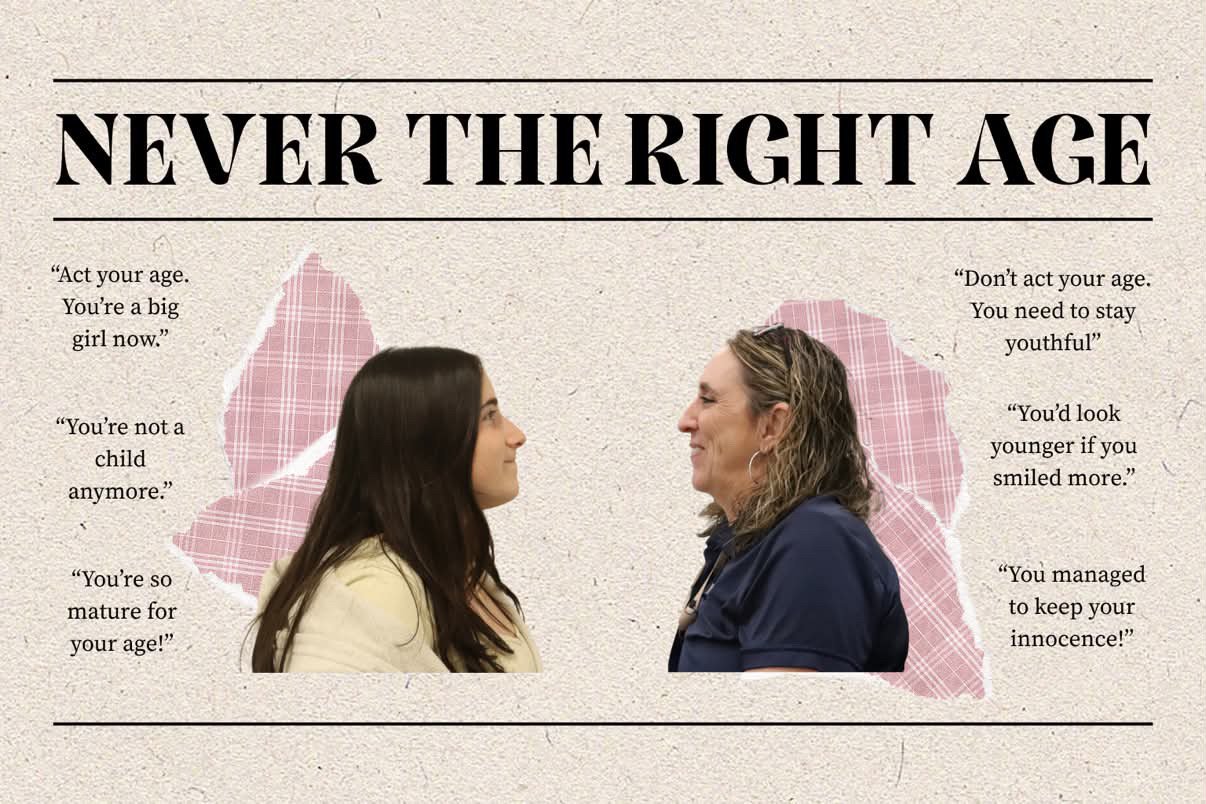
“Act your age. You’re a big girl now.” “Don’t act your age. You need to stay youthful.”
“You’re not a child anymore.” “You’d look younger if you smiled more.”
“You’re so mature for your age!” “You managed to keep your innocence.”
Although these statements may seem harmless, they reflect a contradictory set of expectations placed on women throughout their lives. From a young age, women are praised for acting older and more mature, yet are encouraged to appear younger, more innocent, and more youthful as they grow up. A double standard is defined as an unfair expectation placed on a specific group that does not apply to others, and these conflicting messages create nothing but that. Women encounter double standards in many areas of life. For example, in the workplace, society expects them to be both authoritative and agreeable. By expecting girls to grow up quickly while encouraging women to remain youthful, society creates a double standard that harms women's mental well-being and prevents them from defining maturity on their own terms.
From an early age, society subjugates women to double standards. As girls, they're praised for being “mature for their age,” encouraged to take on responsibilities, emotional labor, and other behaviors associated with adulthood. Research supports the idea that girls are often expected to develop emotional skills early in life. A 2025 study of 721 students at the University of Zaragoza found that women scored higher than men in several areas of emotional intelligence, including recognizing, expressing, and regulating emotions. When displaying emotional intelligence, older people compliment them for being able to be “such an adult amongst other kids.” Younger girls are also subject to more emotional conversations, most being with parents. Many girls find themselves taking on emotional burdens from their family in their early childhood. Starting in elementary school, many girls recall being assigned to sit next to a loud and rowdy boy to "take care of them". Teachers order them to help the boy learn, ake notes,set an example of how he should behave. An article says that society often sends girls mixed messages about their abilities and values. As children, they are praised for their intelligence, creativity, and potential, but as they grow older and enter professional environments, they are likely to face to face doubts about their competence and leadership compared to men. This shift reveals a persistent double standard that limits how women are perceived and treated in adulthood.
Ironically, when these young, mature girls grow up and begin to assert this same maturity and responsibility in the work force, they’re told that they’re acting “aggressive”, and “out of line”. Many hear advice to be quiet and conceal their personality. They're expected to act innocent, yet mature, to give off a good impression. They’re taught to not correct anyone, especially a male, because it’s not her place to. As one author points out in an article, the pressure on women to remain youthful reveals a deeper societal bias. Rather than celebrating the confidence, knowledge, and independence that come with age, society often rewards qualities associated with youth, such as inexperience and impressionability. As a result, many women face unfair expectations that tie their worth to how young they appear rather than who they are or what they have accomplished. It’s not just about looking or acting younger, but rather acting as impressionable as a younger girl. Additionally, newuniversity.org mentions that when looking to achieve leadership positions, offices tell women to replicate the leadership styles of male coworkers in order to achieve those goals. However, research indicates that this can have the opposite effect, and tends to make women less appreciated in the workforce.
This system creates a toxic and misogynistic environment in which women are judged at every stage of life. There is no point at which they can simply "act their age" because acting their age is often seen as either too mature or too immature, too assertive or too passive, too much or not enough. These contradictory expectations can damage self-esteem, increase stress, and make women feel like they can never meet society's standards. Rather than allowing age-based stereotypes to define women, society should recognize that age, appearance, and gender do not determine maturity. Women should have the freedom to express themselves, pursue their goals, and develop their identities without unfair double standards confining them throughout their lives.