

From Plato to ChatGPT
Artificial intelligence is transforming how schools define education, raising a new question: What its role should be
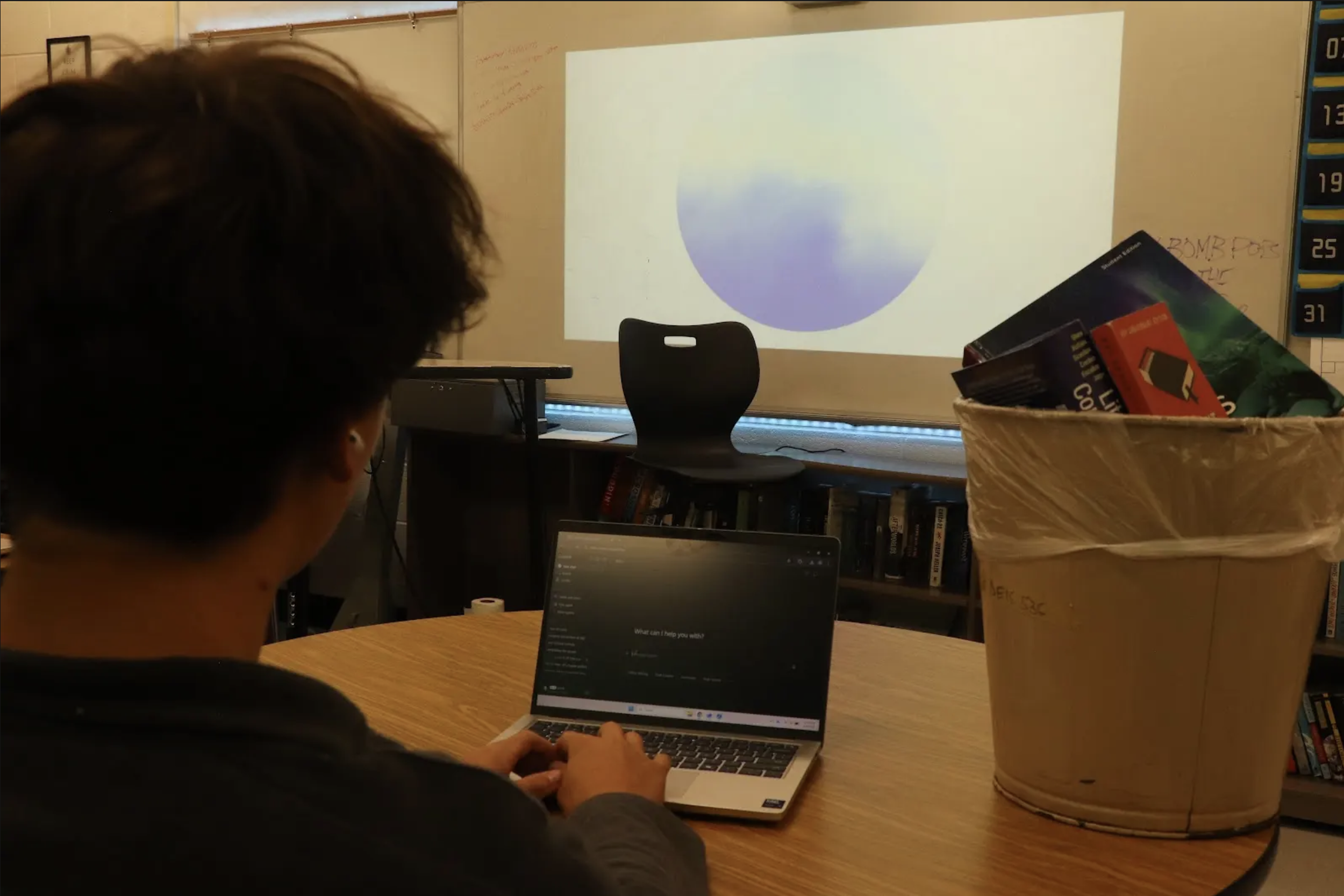
Photo by Allen Liu and Arshita Sunnam.
Allen Liu, Managing Editor, Arshita Sunnam, Copy Editor, & Dylan Gooch, Staff Writer
Every technological revolution seems to arrive with prophecies of doom and desolation. More than two millennia ago, Plato recounted the story of an Egyptian king who rejected a new emerging technology: writing. In Plato's telling, he argued that the instrument of writing would "implant forgetfulness" in people's souls because they would come to rely on external symbols rather than their own memory. What we now consider one of humanity's greatest intellectual achievements was once viewed as a threat to knowledge itself.
Today, writing is so essential to all aspects of civilization that it is almost impossible to imagine life without it. One can’t help but draw parallels from Plato’s bizarre prediction to modern-day pundits and critics. The arrival of artificial intelligence (AI) has been one of the most pivotal technological advancements in recent history, with the potential to further develop and reconstruct the human race. Yet, critics warn that reliance on AI would diminish students' capacity for independent thinking and problem-solving skills, and erode their very minds. Sound familiar?
The question facing schools is not unlike the one Plato wrestled with centuries ago: When a new technology changes how we learn, are we witnessing the decline of human ingenuity or the next stage in its evolution?
In a classroom setting, AI can manifest as an educational aide not only for the students but, more importantly, for the teachers. For instance, AIs such as Chatbot, Gemini, and Claude can make learning more engaging by personalizing lessons to specific students' needs. AI can retain an archive of students' learning techniques in a way that a teacher with 30+ students cannot. Additionally, teachers who would otherwise spend hours creating classwork and interactive practices for their students can now input a subject into AI to configure accurate, interactive, and challenging work for the students.
Perhaps the strongest argument in favor of AI in the classroom is its ability to personalize learning on a massive scale. In a traditional classroom, a teacher may have 30 or more students with different learning styles, strengths, and weaknesses. AI-powered educational tools can adapt explanations, practice problems, and feedback to each individual student's needs. A struggling algebra student might receive additional guided practice, while an advanced learner can move ahead without waiting for the rest of the class. In this sense, AI functions as a personalized tutor available at any hour of the day. Supporters argue that such adaptability could help close learning gaps and make education more accessible to students who need extra support.
Aarya Parthasarathy, a sophomore at Northview High School, recounts his experience with AI personalization.
“During biology last year, sometimes I didn't understand a concept that my teacher was explaining, and I would just go to AI and ask it to dumb it down for me based on previous chats,” Parthsarathy said.
AI's benefits extend beyond students. Teachers spend countless hours outside the classroom creating lesson plans, grading assignments, and preparing instructional materials. AI can automate many of these repetitive tasks, generating quizzes, creating differentiated assignments, and even providing preliminary grading based on teacher-created rubrics. This increased efficiency allows educators to devote more time to the uniquely human aspects of teaching, such as mentoring students, facilitating discussions, and building relationships. While some fear that AI could eventually replace teachers, most educators reject this idea, arguing that no algorithm can replicate the empathy, encouragement, and personal connections that effective teachers provide. According to the Walton Family Foundation "Engaged students are thriving and looking ahead with confidence, but too many Gen Z youth are missing the support, belonging and connection that make them feel engaged at school." This lack of human support denies the teacher- student interactions that can prepare them for the real world.
But the fact is, AI has already started to replace teachers in certain schools and proves to be adept at introducing topics, explaining them, and producing exceptional scores. Alpha School is an AI-powered personalized learning system that has completely replaced human teachers with artificial intelligence. According to the Alpha school, students grew 2.6 times faster than other educational peers on nationally normed MAP tests. However, the cost to attend the school is anything but cheap, as tuition is rising to around $75,000 a year, similar to college tuition. Without considering cost, is it possible that students can truly acquire knowledge without human connections from teachers?
Jesse Hancock, an AP Research teacher at Northview High School, explains the importance of human connection.
“I don't think a computer or AI can ever provide the connections you make with students and the interactions," Hancock said, "To me, that's what high school is all about. I may not remember exactly what you taught me, but I remember you and how helpful you were and how you made me feel when you worked with me.”
Despite its potential benefits, AI has introduced significant concerns about academic integrity. Tools such as ChatGPT can generate essays, answer homework questions, and solve complex problems within seconds. As a result, teachers face growing challenges in determining whether submitted work truly reflects a student's understanding. Critics argue that widespread AI use may encourage students to prioritize completion over comprehension, turning learning into a process of obtaining answers rather than developing knowledge. The concern is not simply that students might cheat, but that they may gradually lose opportunities to practice critical thinking, problem-solving, and independent reasoning.
Beyond cheating, many educators worry that excessive reliance on AI could undermine the learning process itself. Educational growth often occurs through struggle: revising a difficult essay, working through a challenging math problem, or conducting research independently. AI can remove much of this productive struggle by instantly providing polished responses and solutions. While this convenience can save time, it may also reduce opportunities for students to develop resilience, creativity, and analytical skills. Some researchers caution that if students begin outsourcing too much thinking to AI systems, they risk becoming consumers of information rather than active learners.
Justin Sun, a freshman at the Georgia Institute of Technology, educational influencer, and founder of @justinbuilds.mov, (a platform Sun uses to educate others on many STEAM subjects such as programming, math, physics and technology) shares his perspective.
“AI can save me an hour of work, but sometimes that hour is where the learning happens. There's a difference between finishing an assignment and developing the skills the assignment was meant to teach,” Sun said.
The usage of AI affects a lot more than simply a lack of learning and comprehension; it also impacts students' mental health and cognitive abilities. The Flynn Effect is a phenomenon that dictates each generation gets steadily smarter over time. However, in recent years, each generation has not shown an increase in intelligence -- if anything, it has been on a steady downward trend. This spectacle has been attributed to the prevalence of social media and the availability of modern technologies. AI has the increasing potential to accelerate this decline as people become more and more reliant on it.
"Part of the process of learning is getting things wrong and having to work through that process of trial and error, basically. And the AI removes that trial and error thing," Hancock said.
Most teachers would rather use AI as a tool to aid themselves rather than AI truly teaching a student. A student may disagree with that, as AI has proven to be an effective teacher. Students such as Aarya could understand knowledge at a higher level and even prefer learning from an AI. There are many view points on the matter, whether someone views AI as a threat or an ally, the reality is that AI in education has already been implemented. It has already been proven to be effective, and shape the future. So you make the decision, is AI in education a plausible future, not for your teachers, not for your peers, but for you?